


Page 316 - Adsorption, Ion Exchange & Catalysis- 2007, Elsevier - Copy
P. 316
Else_AIEC-INGLE_cH004.qxd 7/1/2006 6:53 PM Page 312
312 4. Adsorption and Ion Exchange
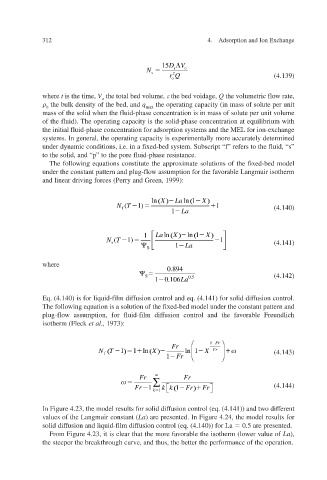
15 DV
N s o
s 2
rQ o (4.139)
where t is the time, V o the total bed volume, the bed v oidage, Q the v w rate, olumetric flo
the bulk density of the bed, and q max the operating capacity (in mass of solute per unit
b
mass of the solid when the fluid-phase concentration is in mass of solute per unit v olume
of the fluid). The operating capacity is the solid-phase concentration at equilibrium with
the initial fluid-phase concentration for adsorption systems and the MEL for ion-exchange
systems. In general, the operating capacity is experimentally more accurately determined
ix
under dynamic conditions, i.e. in a fed-bed system. Subscript “f” refers to the fluid, “s”
to the solid, and “p” to the pore fluid-phase resistance.
The following equations constitute the approximate solutions of the fed-bed model ix
under the constant pattern and plug-flow assumption for the f orable Langmuir isotherm v a
and linear driving forces (Perry and Green, 1999):
ln X () La ln 1 ( X )
NT ( 1) 1
f (4.140)
1 La
1 La X ln () ln 1 ( X )
NT ( s 1) 1
S 1 La (4.141)
where
0.894
(4.142)
S
1 0.106 La 0.5
Eq. (4.140) is for liquid-film diffusion control and eq. (4.141) for solid diffusion control.
The following equation is a solution of the fixed-bed model under the constant pattern and
plug-flow assumption, for fluid-film diffusion control and the forable Freundlich v a
isotherm (Fleck et al ., 1973):
1 Fr
Fr
NT ( ) 1 1 ln ( X ) ln 1 X Fr
f (4.143)
1 Fr
Fr Fr
∑
Fr 1 k k Fr 1 ( Fr) (4.144)
k 1
In Figure 4.23, the model results for solid dif ferent fusion control (eq. (4.141)) and tw o dif
values of the Langmuir constant ( La ) are presented. In Figure 4.24, the model results for
solid diffusion and liquid-film diffusion control (eq. (4.140)) for La 0.5 are presented.
From Figure 4.23, it is clear that the more forable the isotherm (lower value of a v La ),
e,
the steeper the breakthrough curv and thus, the better the performance of the operation.

