


Page 315 - Adsorption, Ion Exchange & Catalysis- 2007, Elsevier - Copy
P. 315
Else_AIEC-INGLE_cH004.qxd 7/1/2006 6:53 PM Page 311
4.2 Design of Adsorption and Ion-Exchange Processes 311
Predictive models
Mass transfer–controlled systems—“diffusion” models and single r esistance to diffu-
sion Predictive models can be used to model the removal process and determine the con-
trolling step of the whole phenomenon. In most cases, particle diffusion within the solid
matrix is the controlling mechanism. But the controlling step is strongly dependent on
elocity fluid linear v, since at low velocities the fluid-film diffusion step could be the con-
Thus, trolling mechanism. as a f the lowest possible linear velocity could be used irst step,
for the evaluation of the controlling step. To use simplified models, the follo wing assump-
tions should be met.
1. Plug flow : In this case, the first term in eq. (4.128) is neThis assumption glected.
holds only if the axial Peclet number of the bed ( Pe L ) is greater than about 100
(Levenspiel, 1972). For packing materials of irregular shape, such as zeolites and
activated carbon, and 0.5 mm particle size, a bed of 50-cm height is suf for icient, f
superficial velocities higher than about 0.2 cm/s (Inglezakis et al ., 2001). Ho , er v we
by using upflow operation, this value could be by far lo. Generally by using
,
wer
upflow mode, the quality of the flow is much better especially at lo , w v elocities.
2. Constant pattern condition : This condition reduces the mass balance equation
(4.128) to the simple relation: C / C =q o / q max (see the section A look into the “constant
pattern” condition ). Practically, the constant pattern assumption holds if the equilib-
rium is favorable, and at high residence times (Perry and Green, 1999; 1959; ers, v e W
Michaels, 1952; Hashimoto et al ., 1977). Ho the constant pattern assumption v er , we
is “weak” if the system exhibits very slow kinetics (W 1959). e ers, v
Various simplified models under the aboe assumptions hae been proposed and ana- v
v
lyzed in the related literature and are in the form of either arithmetic or analytical solu-
tions. In the follo simplified models will be presented under the two commonly
wing,
,
applied assumptions, namely the constant pattern and plug-flow assumptions. The fol-
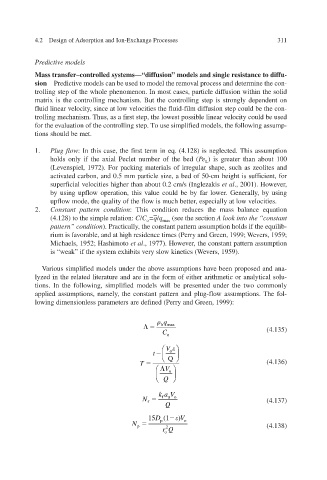
lowing dimensionless parameters are defined (Perry and Green, 1999):
q
bma x
C o (4.135)
V
t Q o
T (4.136)
V
Q o
ka V fu o
N f (4.137)
Q
15 D(1 p ) V o
N p 2 (4.138)
rQ
o

