


Page 320 - Adsorption, Ion Exchange & Catalysis- 2007, Elsevier - Copy
P. 320
Else_AIEC-INGLE_cH004.qxd 7/1/2006 6:53 PM Page 316
316 4. Adsorption and Ion Exchange
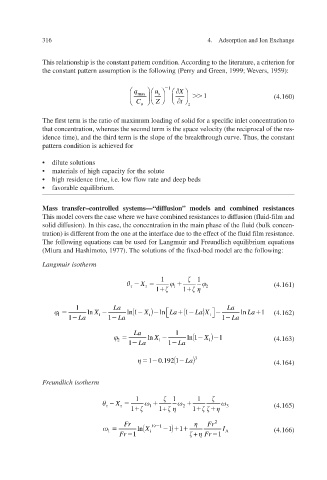
This relationship is the constant pattern condition. According to the literature, a criterion for
evers, the constant pattern assumption is the following (Perry and Green, 1999; 1959): W
q max u s 1 X
C o Z t z 1 (4.160)
The first term is the ratio of maximum loading of solid for a specific inlet concentration to
elocity (the reciprocal of the res- that concentration, whereas the second term is the space v
idence time), and the third term is the slope of the breakthrough curv the constant Thus, e.
v ed for pattern condition is achie
• dilute solutions
• materials of high capacity for the solute
• high residence time, i.e. low rate and deep beds w flo
• favorable equilibrium.
Mass transfer–controlled systems—“diffusion” models and combined r esistances
This model covers the case where we have combined resistances to diffusion (fluid-film and
solid diffusion). In this case, the concentration in the main phase of the fluid (bulk concen-
tration) is different from the one at the interface due to the effect of the fluid film resistance.
The following equations can be used for Langmuir and Freundlich equilibrium equations
(Miura and Hashimoto, 1977). wing: ed-bed model are the follo ix The solutions of the f
Langmuir isotherm
1 1
X 2 (4.161)
1
1 1
1 La La
La X
ln X i ln 1 X ln La 1 i ln La 1 (4.162)
1
i
1 La 1 La 1 La
La 1
ln X i ln 1 X 1 (4.163)
2
i
1 La 1 La
0.192 1 La 3 (4.164)
1
Freundlich isotherm
1 1 1
− X (4.165)
2
3
1
1 + 1 1
Fr 1 Fr 2
1
ln X i Fr 1 A I (4.166)
1
Fr 1 Fr 1
+

