


Page 324 - Adsorption, Ion Exchange & Catalysis- 2007, Elsevier - Copy
P. 324
Else_AIEC-INGLE_cH004.qxd  7/1/2006  6:53 PM  Page 320
                    320                                          4. Adsorption and Ion Exchange


                                                        1


                                                       0.8


                                                       0.6

                                X
                                                       0.4


                                                       0.2                 ζ =0.0001
                                                                           ζ =1
                                                                           ζ =10000
                                                        0
                                 -5      -3       -1      1        3        5
                                                       Θτ  -X  τ
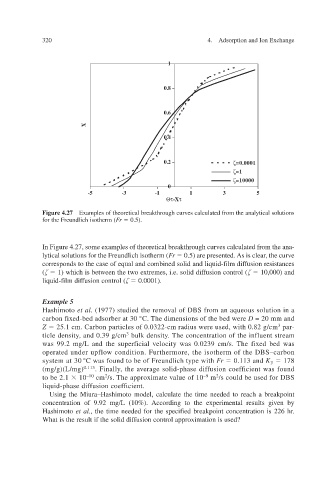
                    Figure 4.27  Examples of theoretical breakthrough curves calculated from the analytical solutions
                    for the Freundlich isotherm (  Fr    0.5).


                    In Figure 4.27, some e es calculated from the ana-  xamples of theoretical breakthrough curv
                    lytical solutions for the Freundlich isotherm (  Fr    0.5) are presented. the curv , As is clear  e
                    corresponds to the case of equal and combined solid and liquid-film diffusion resistances
                    ( 	   1) which is between the two e i.e. solid diffusion control ( xtremes,  	   10,000) and
                    liquid-film diffusion control (  	   0.0001).


                    Example 5
                    Hashimoto   et al  . (1977) studied the removal of DBS from an aqueous solution in a
                    carbon fixed-bed adsorber at 30 °C. The dimensions of the bed were   D  = 20 mm and
                    Z   25.1 cm. Carbon particles of 0.0322-cm radius were used, with 0.82 g/cm  3  par-
                    ticle density and 0.39 g/cm  3  bulk densityThe concentration of the influent stream
                                              .
                     ,
                    was 99.2 mg/L and the superficial velocity was 0.0239 cm/s.  The fixed bed was
                    operated   under upflow condition. Furthermore, the isotherm of the DBS–carbon
                    system at 30 °C was found to be of Fr  eundlich type with   Fr    0.113 and   K    178
                                                                                     F
                    (mg/g)(L/mg)  0.113  . Finally the average solid-phase diffusion coefficient was found
                                    ,
                    to be 2.1     10  –10  cm  2  /s. The approximate value of 10  –9  m  2  /s could be used for DBS
                    liquid-phase diffusion coefficient.
                      Using the Miura–Hashimoto model, calculate the time needed to reach a breakpoint
                    concentration of 9.92 mg/L (10%).  According to the experimental results gien by v
                    Hashimoto   et al  ., the time needed for the specified breakpoint concentration is 226 hr .
                    What is the result if the solid diffusion control approximation is used?

