


Page 328 - Adsorption, Ion Exchange & Catalysis- 2007, Elsevier - Copy
P. 328
Else_AIEC-INGLE_cH004.qxd 7/1/2006 6:53 PM Page 324
324 4. Adsorption and Ion Exchange
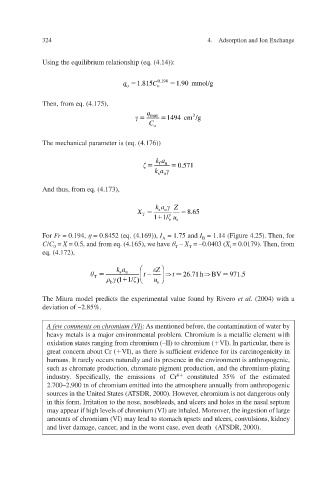
Using the equilibrium relationship (eq. (4.14)):
q o 1.815 C o 0.194 1.90 mmol/g
Then, from eq. (4.175),
q
max 1494 /g c m 3
C
o
The mechanical parameter is (eq. (4.176))
ka
fu 0.571
ka su
And thus, from eq. (4.173),
ka su Z
X T 8.65
11/ u s
For Fr = 0.194, = 0.8452 (eq. (4.169)), I A = 1.75 and I B = 1.14 (Figure 4.25). Then, for
C / C 0 = X = 0.5, and from eq. (4.165), we ha v e – X T = –0.0403 ( X i = 0.0179). Then, from
T
eq. (4.172),
ka Z
su t t 26.71 h BV 971.5
T
b (
11/ ) u s
The Miura model predicts the experimental value found by Ri v ero et al . (2004) with a
deviation of –2.85%.
A f e w comments on c hr omium (VI) : As mentioned before, the contamination of w ater by
heavy metals is a major environmental problem. Chromium is a metallic element with
oxidation states ranging from chromium (–II) to chromium ( there is , VI). In particular
great concern about Cr ( as there is sufvidence for its carcinogenicity in f icient e
VI),
humans. It rarely occurs naturally and its presence in the environment is anthropogenic,
such as chromate production, chromate pigment production, and the chromium-plating
industry. Specif the emissions of Cr 6 constituted 35% of the estimated
,
ically
2.700–2.900 tn of chromium emitted into the atmosphere annually from anthropogenic
sources in the United States (ATSDR, 2000). However, chromium is not dangerous only
in this form. Irritation to the nose, nosebleeds, and ulcers and holes in the nasal septum
may appear if high levels of chromium (VI) are inhaled. Moreover, the ingestion of large
amounts of chromium (VI) may lead to stomach upsets and ulcers, con kidne vulsions, y
and liver damage, cancer and in the w e2000). orst case, TSDR, v en death (A
,

