Page 332 - Adsorption, Ion Exchange & Catalysis- 2007, Elsevier - Copy
P. 332
Else_AIEC-INGLE_cH004.qxd  7/1/2006  6:54 PM  Page 328
                    328                                          4. Adsorption and Ion Exchange


                                                   ,
                    2001; Zulfadhly   et al  ., 2001; K o   et al  ., 2000, 2002; Sag and 2001), dyes adsorption Actay
                       v
                    using metal hydroxide and actiated carbon (Netpradit   et al  ., 2004; W and er  alk
                    Weatherley, 1997; K o   et al  ., 2002), and phenol biosorption using biomass (Rao and
                    Viraraghavan, 2002).

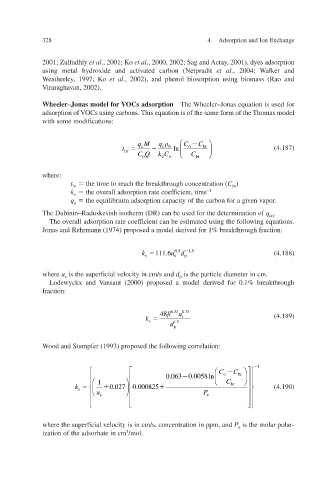
                    Wheeler–Jonas model f OCs adsor ption or  V  The Wheeler–Jonas equation is used for
                    adsorption of VOCs using carbons. This equation is of the same form of the Thomas model
                    with some modif ications:


                                               qM e  q      C   o  C    br  
                                                      eb
                                           t  br          ln                        (4.187)
                                               CQ  o  kC  v  o    C  br  
                    where:
                            t  br    the time to reach the breakthrough concentration (  C  br  )
                            k  v    the oerall adsorption rate coef time icient, f v  –1
                            q  e    the equilibrium adsorption capacity of the carbon for a gi . en v v apor
                    e The Dubinin–Raduskvish isotherm (DR) can be used for the determination of   q  eq  .
                      v The oerall adsorption rate coeficient can be estimated using the following equations. f
                    Jonas and Rehrmann (1974) proposed a model deried for 1% breakthrough fraction: v


                                                 k  111.6  u d s  0.5   1.5           (4.188)

                                                             p
                    where   u  s  is the superficial velocity in cm/s and   d  p  is the particle diameter in cm.
                         v
                      Lodewyckx and  Vansant (2000) proposed a model deried for 0.1% breakthrough
                    fraction:

                                                      48     0.33  u  0.75
                                                  k         s                         (4.189)

                                                         d  1.5 p

                    Wood and Stampfer (1993) proposed the follo wing correlation:


                                                                    C   C          1
                                                    0.063 0.0058ln        o  br    
                                                                              
                             k       1     0.027  0.000825         C  br        (4.190)

                                   u   s                      P  e           
                                                                               
                                                                               

                    where the superficial velocity is in cm/s, concentration in ppm, and   P  is the molar polar-
                                                                            e
                    ization of the adsorbate in cm  3  /mol.
   327   328   329   330   331   332   333   334   335   336   337