


Page 336 - Adsorption, Ion Exchange & Catalysis- 2007, Elsevier - Copy
P. 336
Else_AIEC-INGLE_cH004.qxd 7/1/2006 6:54 PM Page 332
332 4. Adsorption and Ion Exchange
biologically degradable in the environment, it is not expected to reach high concen-
trations oer time in the environment (A 1989). TSDR,
v
Since toluene is principally released into the atmosphere, it is ob vious that inhalation
is the primary route of e and for occupationally xposure to it for the general population,
exposed individuals. CNS dysfunction and neurological impairment are the main adverse
acute health effects of toluene in humans. At concentrations in the range 50–1500 ppm
v fer dro and for 3–8 h exposure, indi viduals may sufwsiness,e function, impaired cogniti
incoordination, and irritation of the eyes and throat. Increased concentrations may lead to
more severe symptoms like nausea, staggering gait, confusion, e xtreme nervousness, and
even insomnia lasting for seeral days (NTP 1990). At concentrations in the range
v
,
10,000–30,000 ppm, toluene may cause narcosis and death (WHO, 1985).
Helfferich–Glueckauf model for ion exchange Although the models presented in
the previous sections can be successfully applied in practice in ion-exchange systems, the
Helfferich–Glueckauf approach will also be presented, which is deeloped especially for v
ion-exchange systems (Helfferich, 1962). The Helfferich–Glueckauf approach relies
basically on Glueckauf’The concept of “efe plates, originated from the v ” s approach. fecti
,
theory of distillation and first applied to chromatography is of primary importance in
these models. Equilibrium theories also employ this concept and include the plate height
as an empirical quantity. Ho in the following approach, the plate height is calcu-
,
er
we
v
lated from fundamental data and is incorporated in a typical kinetic theory , i.e. an
approach using kinetics and not only equilibrium relationships. The approach is applica-
ble to the so-called self -harpening boundaries in columns, i.e. in the case of f a v orable
equilibrium (Figure 4.31). Furthermore, the equations can be applied only at steady state
conditions, i.e. when the boundaries attain a steady shape. In other words, here we ha e v
models that are based on the constant pattern condition.
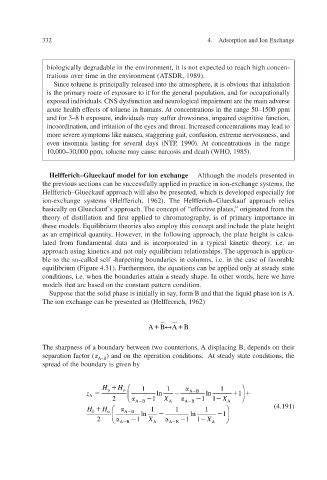
Suppose that the solid phase is initially in say, form B and that the liquid phase ion is A.
The ion exchange can be presented as (Helf 1962) fecrich,
AB AB
The sharpness of a boundary between two counterions, A displacing B, depends on their
separation factor ( ) and on the operation conditions. At steady state conditions, the
A–B
en by v spread of the boundary is gi
H p H o 1 1 1
z ln AB ln 1
A
2 1 X 1 X 1
AB A AB A
H f H o AB ln 1 1 ln 1 1 (4.191)
2 AB 1 A X AB 1 A 1 X 

