


Page 338 - Adsorption, Ion Exchange & Catalysis- 2007, Elsevier - Copy
P. 338
Else_AIEC-INGLE_cH004.qxd 7/1/2006 6:54 PM Page 334
334 4. Adsorption and Ion Exchange
q C / 0.142 ru 2
H P bo o 2 o s (4.193)
bo q ( C / o ) D s
q C / 2 0.266 ru 2
H f bo q bo C / o o D f (1 70 r u) o o s s (4.194)
qC A B YX A B
a AB (4.195)
qC B A YX B A
C A
X A (4.196)
C o
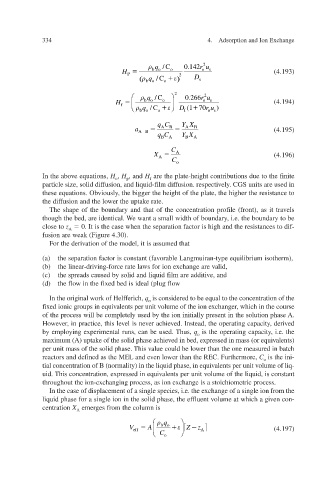
In the aboe equations, v H o , H p , and H f are the plate-height contributions due to the f inite
particle size, solid dif and liquid-f fusion, . CGS units are used in v ely fusion. respecti ilm dif
viously
these equations. Ob, the bigger the height of the plate, the higher the resistance to
the diffusion and the lower the uptake rate.
The shape of the boundary and that of the concentration profile (front), as it tra els v
e w
though the bed, are identical. Want a small width of boundary i.e. the boundary to be ,
close to z A 0. It is the case when the separation factor is high and the resistances to dif-
fusion are weak (Figure 4.30).
v For the deriation of the model, it is assumed that
(a) the separation factor is constant (forable Langmuiran-type equilibrium isotherm), a v
(b) -dri the linearving-force rate laws for ion exchange are v alid,
(c) the spreads caused by solid and liquid film are additi and e, v
(d) ix the flow in the fed bed is ideal (plug flo w
In the original work of Helfferich, q o is considered to be equal to the concentration of the
fixed ionic groups in equivalents per unit volume of the ion exchanger, which in the course
of the process will be completely used by the ion initially present in the solution phase A.
v
However, in practice, this leel is ne the operating capacity deri , ed v
v
er achie
v
ed. Instead,
xperimental runs,
by employing e can be used. Thus, q o is the operating capacity i.e. the ,
maximum (A) uptake of the solid phase achieved in bed, expressed in mass (or equivalents)
per unit mass of the solid phase. This value could be lower than the one measured in batch
reactors and defined as the MEL and even lower than the REC. Furthermore, C o is the ini-
tial concentration of B (normality) in the liquid phase, in equivalents per unit volume of liq-
This concentration,
uid. e is constant v alents per unit v olume of the liquid, xpressed in equi
throughout the ion-exchanging process, as ion e xchange is a stoichiometric process.
In the case of displacement of a single species, i.e. the e xchange of a single ion from the
liquid phase for a single ion in the solid phase, the effluent volume at which a gi en con- v
centration X A emerges from the column is
q
z
V A bo Z
eff C o A (4.197)

