


Page 343 - Adsorption, Ion Exchange & Catalysis- 2007, Elsevier - Copy
P. 343
Else_AIEC-INGLE_cH004.qxd 7/1/2006 6:54 PM Page 339
4.2 Design of Adsorption and Ion-Exchange Processes 339
diffusion control there is no effect of the linear velocity on the kinetics in the bed, while for
act,
film-diffusion control the kinetics will be affected. In f this is a scale-up procedure.
From these experiments, a loabo wer limit of the linear v elocity can be found, v e which the
controlling mechanism is the solid diffusion control. Then, for higher linear v elocities,
which are expected in large-scale units, it is guaranteed that the controlling step is unaltered.
Derivation of basic experimental data
Experimentally, it is valuable to determine the following: the maximum adsorption capacity
of the solid ( q max ), the dificients of the solutes in the solid phase ( f fusion coef D ), and the
s
equilibrium isotherm. Theoretically the equilibrium isotherm, the maximum adsorption
,
capacity, and the solid diffusion coefficient for a specific ion-exchange or adsorption system
are independent of the experimental method used for their determination and independent of
flow conditions (Helfferich, 1962; Lieu and Weber, 1981; Chen and Wang, 2004; Fernandez
et al ., 1996). Ho e v er , we xchange and adsorption sys- xperimental results obtained in ion-e
tems showed that the maximum adsorption capacity measured in a fixed bed is different from
that measured in a batch system, and it might be flow-rate dependent (Inglezakis et al ., 2002;
Inglezakis and Grigoropoulou, 2003; Hlavay et al ., 1982; McKay and Bino, 1985; McLaren
and Farquhar, 1973; Netpradit et al ., 2004; K o et al ., 2003; Sen et al ., 2002). Furthermore,
as shown in the cases of adsorption on activated carbon and the removal of Cr (III) using zeo-
lite NaX, the equilibrium isotherm is influenced by the type of the reactor used for its meas-
urement (fixed-bed and batch reactor) (Weber and Wang, 1987; Barros et al ., 2006). Finally ,
the diffusion coefficient may be different when measured in fixed beds or batch systems, and
in some cases is found to be flow-dependent (Inglezakis and Grigoropoulou, 2003; Yoshida
eber and Smith,
et al ., 1984; W 1987; McKay and Bino, 1985; K o et al ., 2003; Mark o vska
et al ., 2001). ations seem to be a result of the limiting (low) contact time in All these observ
fixed beds and of the different concentration gradients in fed beds and batch reactors
ix
(Inglezakis and Grigoropoulou, 2003; Ko et al ., 2003). It must be recognized that batch reac-
ed-bed v tors do not approximate the hydrodynamic and contaminant remoal patterns of f ix
(column) reactors (Weber and Smith, 1987). Another reason responsible for such differences
between batch and fixed-bed parameters is the lack of adequate mechanical strength of par-
ticles (compressed particles due to flow pressure) and the permeability of particles to fluid
flow (Fernandez et al , ., 1996). Ob viously this case is possible only when resins are used.
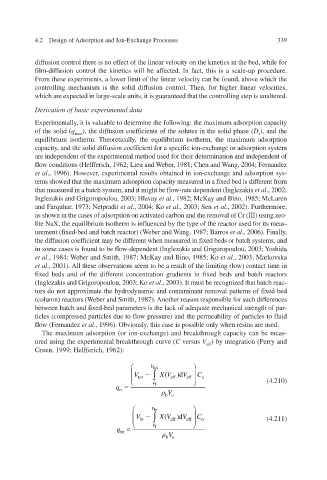
The maximum adsorption (or ion-exchange) and breakthrough capacity can be meas-
ured using the experimental breakthrough curve ( C v ersus V eff ) by integration (Perry and
Green, 1999; Helf 1962): ferich,
V tot
V ∫ X V ( V ) d C
tot eff eff o (4.210)
q o V f
bo V
V br
V ∫ X V ( V ) d C
br eff eff o (4.211)
q br = V f
bo V

