


Page 340 - Adsorption, Ion Exchange & Catalysis- 2007, Elsevier - Copy
P. 340
Else_AIEC-INGLE_cH004.qxd  7/1/2006  6:54 PM  Page 336
                    336                                          4. Adsorption and Ion Exchange


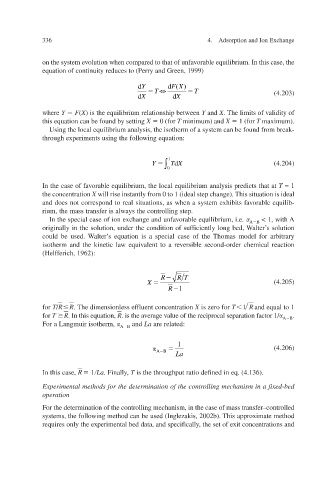
                    on the system evolution when compared to that of unfavorable equilibrium. In this case, the
                    equation of continuity reduces to (Perry and Green, 1999)
                                               d Y      d( ) FX
                                                    T          T
                                               d X       d X                          (4.203)

                    where   Y    F ( X ) is the equilibrium relationship between   Y and   X . The limits of v alidity of
                    this equation can be found by setting   X    0 (for   T minimum) and   X    1 (for   T maximum).
                      Using the local equilibrium analysis, the isotherm of a system can be found from break-
                    wing equation: through experiments using the follo


                                                        1
                                                   Y   ∫  T X d                       (4.204)
                                                        0
                     a
                    In the case of forable equilibrium, the local equilibrium analysis predicts that at   T  = 1
                     v
                    the concentration   X will rise instantly from 0 to 1 (ideal step change).  This situation is ideal
                    and does not correspond to real situations, as when a system exhibits forable equilib- v a
                    rium, the mass transfer is alays the controlling step.   w
                      In the special case of ion exchange and unforable equilibrium, i.e.  v a    A   B  < 1, with  A
                    originally in the solution, under the condition of suficiently long bed, W f  s solution alter’
                    could be used.  Ws equation is a special case of the  Thomas model for arbitrary
                     alter’
                    isotherm and the kinetic law equialent to a reersible second-order chemical reaction v
                      v
                    (Helfferich, 1962):

                                                      R    R T
                                                  X                                   (4.205)
                                                        R  1


                    for   T / R  R . The dimensionless effluent concentration   X is zero for   T  1  R  and equal to 1
                    for   T
R  . In this equation,  R  alue of the reciprocal separation f  erage v v . is the a    A   B  .
                                          actor 1/
                    For a Langmuir isotherm,    A   B  and   La  are related:

                                                           1
                                                      AB                              (4.206)
                                                          La


                    In this case,  R    1  La  . Finally,  T is the throughput ratio defined in eq. (4.136).
                    Experimental methods for the determination of the controlling mechanism in a f ixed-bed
                    operation
                    For the determination of the controlling mechanism, in the case of mass transfer–controlled
                    systems, the following method can be used (Inglezakis, 2002b).  This approximate method
                    , requires only the experimental bed data, and specifthe set of e ically  xit concentrations and

