


Page 341 - Adsorption, Ion Exchange & Catalysis- 2007, Elsevier - Copy
P. 341
Else_AIEC-INGLE_cH004.qxd  7/1/2006  6:54 PM  Page 337
                  4.2 Design of Adsorption and Ion-Exchange Processes  337


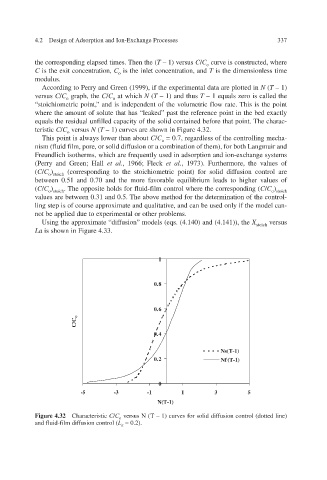
                  the corresponding elapsed times. Then the (  T – 1) v ersus   C / C  o  curve is constructed, where
                  C is the e xit concentration,  C  o  is the inlet concentration, and   T is the dimensionless time
                  modulus.
                    According to Perry and Green (1999), if the experimental data are plotted in   N  ( T – 1)
                  versus   C / C  o  graph, the   C / C  o  at which   N  ( T – 1) and thus   T – 1 equals zero is called the
                  ”
                  “stoichiometric point, and is independent of the volumetric flow rate. This is the point
                   ed”
                  where the amount of solute that has “leak past the reference point in the bed e xactly
                  equals the residual unfilled capacity of the solid contained before that point. The charac-
                  teristic   C / C  o  versus   N  ( T – 1) curves are shown in Figure 4.32.
                    This point is alays lower than about  w  C / C  o  = 0.7, regardless of the controlling mecha-
                  nism (fluid film, pore, or solid diffor both Langmuir and fusion or a combination of them),
                  Freundlich isotherms, which are frequently used in adsorption and ion-exchange systems
                  (Perry and Green; Hall   et al  ., 1966; Fleck   et al  ., 1973). Furthermore, the values of
                  ( C / C ) o  stoich  (corresponding to the stoichiometric point) for solid diffusion control are
                     v
                  between 0.51 and 0.70 and the more forable equilibrium leads to higher values of
                     a
                  ( C / C ) o  stoich  . The opposite holds for fluid-film control where the corresponding (  C / C ) o  stoich
                  values are between 0.31 and 0.5. The aboe method for the determination of the control- v
                  v
                  ling step is of course approximate and qualitati and can be used only if the model can-
                  e,
                  not be applied due to experimental or other problems.
                    Using the approximate “dif models (eqs. (4.140) and (4.141)), the   X  stoich  versus
                    fusion”
                  La  is shown in Figure 4.33.


                                                     1


                                                    0.8


                                                    0.6
                              o
                              C/C
                                                    0.4

                                                                       Ns(T-1)
                                                    0.2                Nf (T-1)


                                                     0
                               -5      -3      -1       1       3        5
                                                     N(T-1)
                  Figure 4.32  Characteristic   C / C  versus N (T – 1) curves for solid diffusion control (dotted line)
                                          o
                  and fluid-film diffusion control (  L  = 0.2).
                                           a

