


Page 339 - Adsorption, Ion Exchange & Catalysis- 2007, Elsevier - Copy
P. 339
Else_AIEC-INGLE_cH004.qxd 7/1/2006 6:54 PM Page 335
4.2 Design of Adsorption and Ion-Exchange Processes 335
or in terms of time,
q
z
A C bo Z A (4.198)
tX( ) o
A
Q
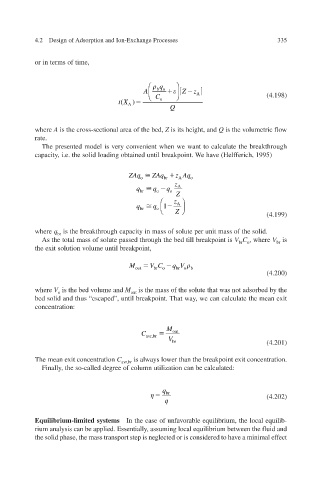
where A is the cross-sectional area of the bed, Z is its height, and Q is the v w olumetric flo
rate.
v
The presented model is very conenient when we want to calculate the breakthrough
capacity, i.e. the solid loading obtained until breakpoint. 1995) ferich, e (Helf e ha W v
q
ZA q ZA z A q br A o
o
z A
q br q o q o
Z
z A
q br q o 1 Z
(4.199)
where q br is the breakthrough capacity in mass of solute per unit mass of the solid.
As the total mass of solute passed through the bed till breakpoint is V br C , where V br is
o
the exit solution volume until breakpoint,
M V C q V
out br o br o b
(4.200)
where V is the bed volume and M is the mass of the solute that was not adsorbed by the
o out
,
bed solid and thus “escaped”, until breakpoint. That w we can calculate the mean e xit
ay
concentration:
M
C out
avr,b r
V
br (4.201)
The mean e xit concentration C xit concentration. w is alays lower than the breakpoint e
avr,br
Finally, the so-called degree of column utilization can be calculated:
q
br (4.202)
q
Equilibrium-limited systems In the case of unf the local equilib- a orable equilibrium, v
rium analysis can be applied. Essentially, assuming local equilibrium between the fluid and
the solid phase, the mass transport step is neglected or is considered to have a minimal effect

