


Page 334 - Adsorption, Ion Exchange & Catalysis- 2007, Elsevier - Copy
P. 334
Else_AIEC-INGLE_cH004.qxd  7/1/2006  6:54 PM  Page 330
                    330                                          4. Adsorption and Ion Exchange


                    These equations are applied for the determination of the equilibrium solid loading   q  e  for
                    the specified inlet concentration. To do this, the partial pressure of toluene at inlet condi-
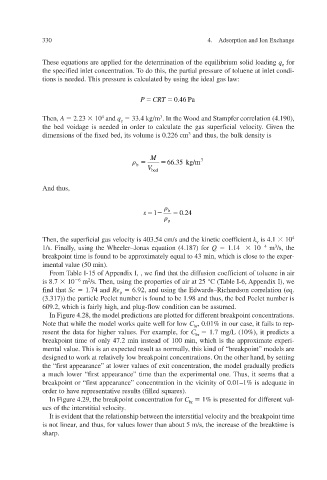
                    tions is needed. This pressure is calculated by using the ideal gas la w:


                                                P         0.46 a  P
                                                  CR
                                                  T
                    Then,  A   2.23     10  4  and   q  e    33.4 kg/m  3  . In the Wood and Stampfer correlation (4.190),
                    the bed voidage is needed in order to calculate the gas superficial v. Gien the v elocity
                    dimensions of the f its volume is 0.226 cm ix ed bed,  3  and thus, the bulk density is


                                                   M             3
                                                        66.35  kg/m
                                               b
                                                  V
                                                   bed
                    And thus,


                                                        b    0.24
                                                    1

                                                        p
                    Then, the superf icient  elocity is 403.54 cm/s and the kinetic coef f icial gas v  k  is 4.1     10  4
                                                                                 v
                    , 1/s. Finally using the Wheeler–Jonas equation (4.187) for   Q    1.14      10    4  m  3  /s, the
                    breakpoint time is found to be approximately equal to 43 min, which is close to the e xper-
                    imental value (50 min).
                      From Table I-15 of Appendix I, , we find that the diffusion coeficient of toluene in air f
                    is 8.7     10    6  m  2  /s. Then, using the properties of air at 25 °C (T Appendix I), we
                                   able I-6,
                    find that   Sc     1.74 and   Re    6.92, and using the Edwards–Richardson correlation (eq.
                                          p
                    (3.317)) the particle Peclet number is found to be 1.98 and thus, the bed Peclet number is
                    609.2, which is fairly high, and plug-flow condition can be assumed.
                      In Figure 4.28, the model predictions are plotted for different breakpoint concentrations.
                    Note that while the model works quite well for lo w   C  , 0.01% in our case, it fails to rep-
                                                               br
                    resent the data for higher values. For e for  xample,  C    1.7 mg/L (10%), it predicts a
                                                                br
                    breakpoint time of only 47.2 min instead of 100 min, which is the approximate e xperi-
                    , mental value. This is an expected result as normally this kind of “breakpoint” models are
                    designed to work at relatively low breakpoint concentrations. On the other hand, by setting
                    the “first appearance” at lower values of exit concentration, the model gradually predicts
                    a much lower “first appearance” time than the experimental one. Thus, it seems that a
                    breakpoint or “first appearance” concentration in the vicinity of 0.01–1% is adequate in
                    e representati v order to hae results (filled squares). v
                      In Figure 4.29, the breakpoint concentration for   C    1% is presented for dif ferent v al-
                                                              br
                    ues of the interstitial v elocity .
                      It is evident that the relationship between the interstitial velocity and the breakpoint time
                    is not linear and thus, for values lower than about 5 m/s, the increase of the breaktime is
                    ,
                    sharp.

