


Page 331 - Adsorption, Ion Exchange & Catalysis- 2007, Elsevier - Copy
P. 331
Else_AIEC-INGLE_cH004.qxd 7/1/2006 6:53 PM Page 327
4.2 Design of Adsorption and Ion-Exchange Processes 327
The Reynolds number is 4.56 and using the Edwards–Richardson correlation (eq. (3.317))
the particle Peclet number is found equal to 2.18 and thus, the bed Peclet number is 2179,
which is fairly high and the plug-flow condition is assured.
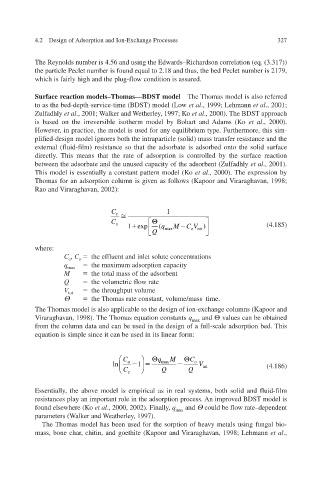
Surface reaction models–Thomas—BDST model The Thomas model is also referred
to as the bed-depth-service-time (BDST) model (Lo w et al ., 1999; Lehmann et al ., 2001;
Zulfadhly et al etherle, y ., 2001; W er 1997; alk and W K o et al ., 2000). The BDST approach
v
is based on the irreersible isotherm model by Bohart and Adams (K o et al ., 2000).
However, in practice, the model is used for any equilibrium type. Furthermore, this sim-
plified-design model ignores both the intraparticle (solid) mass transfer resistance and the
external (fluid-film) resistance so that the adsorbate is adsorbed onto the solid surf ace
directly. This means that the rate of adsorption is controlled by the surface reaction
between the adsorbate and the unused capacity of the adsorbent (Zulf adhly et al ., 2001).
This model is essentially a constant pattern model (K o et al ., 2000). The eby xpression
v
Thomas for an adsorption column is gien as follows (Kapoor and V 1998; an, iraragha v
Rao and Viraraghavan, 2002):
C 1
e
C o
1e ( Q q max M C V o tot ) (4.185)
x
p
where:
C , C o the effluent and inlet solute concentrations
e
q max the maximum adsorption capacity
M the total mass of the adsorbent
Q the volumetric flo w rate
V tot the throughput v olume
the Thomas rate constant, v time.
olume/mass
The Thomas model is also applicable to the design of ion-exchange columns (Kapoor and
Viraraghavan, 1998). The Thomas equation constants q max and values can be obtained
from the column data and can be used in the design of a full-scale adsorption bed. This
equation is simple since it can be used in its linear form:
C q M C
ln C o e 1 max Q o Q V tot (4.186)
Essentially, the aboe model is empirical as in real systems, both solid and fluid-f ilm
v
resistances play An impro an important role in the adsorption process. ved BDST model is
found elsewhere (Ko et al ., 2000, 2002). Finally , q max and could be flo w rate–dependent
parameters (Walker and Weatherley, 1997).
The Thomas model has been used for the sorption of heavy metals using fungal bio-
mass, bone char chitin, and goethite (Kapoor and V 1998; Lehmann iraragha et al .,
v
an,
,

