


Page 313 - Adsorption, Ion Exchange & Catalysis- 2007, Elsevier - Copy
P. 313
Else_AIEC-INGLE_cH004.qxd  7/1/2006  6:53 PM  Page 309
                  4.2 Design of Adsorption and Ion-Exchange Processes  309


                    The effectiveness of a fixed-bed operation depends mainly on its hydraulic performance.
                  Even if the physicochemical phenomena are well understood and their application in prac-
                  tice is simple, the operation will probably f ail if the hydraulic behavior of the reactor is not
                     v
                  adequate. One must be able to recognize the competitie effects of kinetics and fluid
                  dynamics: mixing, dead spaces, and bypasses that can completely alter the performance of
                  the reactor when compared to the “ideal” presentation (Donati and P 1997). The aludetto,
                  main factor of failure in liquid-phase operations is liquid maldistrib which could be ution,
                  related to low liquid holdup in downflow operation, or other design problems. These effects
                  could be critical not only in full-scale but also in pilot- or even in laboratory-scale reactors.

                  ations Basic design consider
                  Material balance  Ion exchange and adsorption from aqueous solutions could be con-
                  sidered as isothermal and isobaric operations, while gas-phase adsorption operations could
                  we be nonisothermal and nonisobaric. Hover, in most en the con- vironmental applications,
                  centration of the gas-phase solute is low, and so the heat released and the pressure drop due
                  w
                  .
                  Thus,
                  to adsorption are lo it can be considered that isothermal and isobaric conditions
                  are met (Murillo   et al  ., 2004; Gupta   et al  ., 2004; Cheng   et al  ., 2004).  Note that pressure
                   v
                  drop could arise not only by the remoal of a considerable amount of a species from a
                  gaseous stream but also due to friction as gas is passed though the bed of solids. Pressure
                  , drop changes the fluid density which in turn influences the volumetric flow rate and thus
                  the superficial fluid velocity. The problem is analogous to the one encountered in catalytic
                  reacting systems where the expansion factor due to the reaction and the pressured drop due
                  to reaction   and  friction are in the picture (see Section 5.3.4). Ho the pressure drop v we er ,
                  due to friction can be considered negligible in most practical applications.
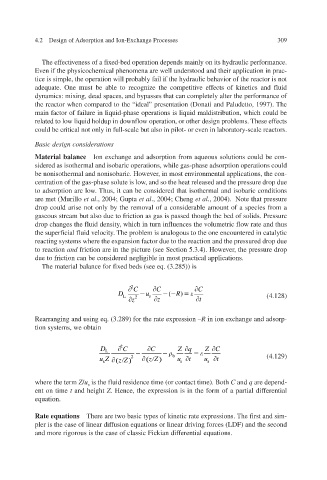
                    The material balance for fed beds (see eq. (3.285)) is ix

                                             2  C    C           C
                                          D  L    u    s  (     R )                 (4.128)
                                              z    2  z          t

                  Rearranging and using eq. (3.289) for the rate e xpression   –R  in ion exchange and adsorp-
                  tion systems, we obtain

                                     D  L  2  C       C         Z   q        Z   C
                                    uZ   (  Z z  )  2   (  Z z  )  b  u  t    u  t       (4.129)
                                     s                      s      s

                  where the term   Z / u is the fluid residence time (or contact time). Both  s  C and   q are depend-
                  ent on time   t and height   Z . Hence, the expression is in the form of a partial dif ferential
                  equation.

                  Rate equations  xpressions.  irst and sim- The f There are two basic types of kinetic rate e
                  pler is the case of linear diffusion equations or linear driving forces (LDF) and the second
                  and more rigorous is the case of classic Fickian dif ferential equations.

