


Page 680 - Advanced_Engineering_Mathematics o'neil
P. 680
660    CHAPTER 18  The Potential Equation

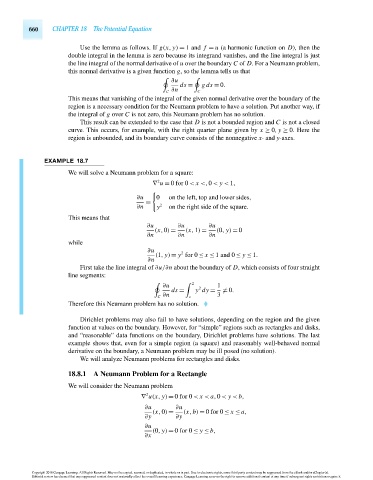
                                    Use the lemma as follows. If g(x, y) = 1 and f = u (a harmonic function on D), then the
                                 double integral in the lemma is zero because its integrand vanishes, and the line integral is just
                                 the line integral of the normal derivative of u over the boundary C of D. For a Neumann problem,
                                 this normal derivative is a given function g, so the lemma tells us that

                                                                ∂u
                                                                   ds =  gds = 0.
                                                              C ∂n      C
                                 This means that vanishing of the integral of the given normal derivative over the boundary of the
                                 region is a necessary condition for the Neumann problem to have a solution. Put another way, if
                                 the integral of g over C is not zero, this Neumann problem has no solution.
                                    This result can be extended to the case that D is not a bounded region and C is not a closed
                                 curve. This occurs, for example, with the right quarter plane given by x ≥ 0, y ≥ 0. Here the
                                 region is unbounded, and its boundary curve consists of the nonnegative x- and y-axes.


                         EXAMPLE 18.7
                                 We will solve a Neumann problem for a square:
                                                            2
                                                          ∇ u = 0for0 < x <,0 < y < 1,

                                                     ∂u    0   on the left, top and lower sides,
                                                        =
                                                     ∂n    y 2  on the right side of the square.
                                 This means that
                                                        ∂u        ∂u       ∂u
                                                           (x,0) =  (x,1) =   (0, y) = 0
                                                        ∂n        ∂n       ∂n
                                 while
                                                         ∂u
                                                                   2
                                                           (1, y) = y for 0 ≤ x ≤ 1 and 0 ≤ y ≤ 1.
                                                         ∂n
                                    First take the line integral of ∂u/∂n about the boundary of D, which consists of four straight
                                 line segments:
                                                                       2
                                                             ∂u         2     1
                                                                ds =   y dy =   = 0.
                                                            C ∂n     o        3
                                 Therefore this Neumann problem has no solution.

                                    Dirichlet problems may also fail to have solutions, depending on the region and the given
                                 function at values on the boundary. However, for “simple” regions such as rectangles and disks,
                                 and “reasonable” data functions on the boundary, Dirichlet problems have solutions. The last
                                 example shows that, even for a simple region (a square) and reasonably well-behaved normal
                                 derivative on the boundary, a Neumann problem may be ill posed (no solution).
                                    We will analyze Neumann problems for rectangles and disks.

                                 18.8.1  A Neumann Problem for a Rectangle
                                 We will consider the Neumann problem
                                                        2
                                                       ∇ u(x, y) = 0for0 < x < a,0 < y < b,
                                                        ∂u       ∂u
                                                          (x,0) =   (x,b) = 0for 0 ≤ x ≤ a,
                                                        ∂y       ∂y
                                                        ∂u
                                                          (0, y) = 0for0 ≤ y ≤ b,
                                                        ∂x


                      Copyright 2010 Cengage Learning. All Rights Reserved. May not be copied, scanned, or duplicated, in whole or in part. Due to electronic rights, some third party content may be suppressed from the eBook and/or eChapter(s).
                      Editorial review has deemed that any suppressed content does not materially affect the overall learning experience. Cengage Learning reserves the right to remove additional content at any time if subsequent rights restrictions require it.

                                   October 14, 2010  15:27  THM/NEIL   Page-660        27410_18_ch18_p641-666

