


Page 681 - Advanced_Engineering_Mathematics o'neil
P. 681
18.8 The Neumann Problem     661


                                        and
                                                                  ∂u
                                                                    (a, y) = g(y) for 0 ≤ y ≤ b.
                                                                  ∂x
                                        For the rectangle, the normal derivative is ∂u/∂x on the vertical sides and ∂u/∂y on the horizontal
                                        sides. As a necessary (but not sufficient) condition for a solution to exist, we assume that
                                                                           b
                                                                           g(y)dy = 0.
                                                                         0
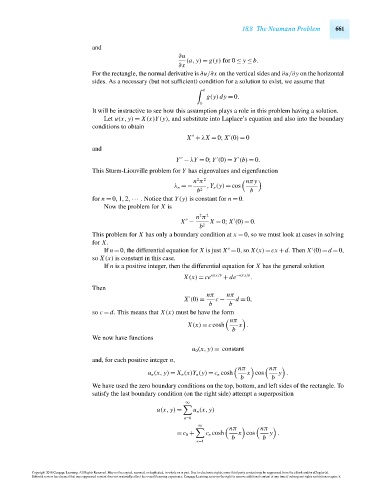
                                        It will be instructive to see how this assumption plays a role in this problem having a solution.
                                           Let u(x, y) = X(x)Y(y), and substitute into Laplace’s equation and also into the boundary
                                        conditions to obtain


                                                                     X + λX = 0; X (0) = 0
                                        and
                                                                 Y − λY = 0;Y (0) = Y (b) = 0.


                                        This Sturm-Liouville problem for Y has eigenvalues and eigenfunction
                                                                        2
                                                                       n π  2          nπy
                                                                 λ n =−    ,Y n (y) = cos
                                                                        b  2            b
                                        for n = 0,1,2,··· . Notice that Y(y) is constant for n = 0.
                                           Now the problem for X is
                                                                         2
                                                                       n π  2

                                                                   X −      X = 0; X (0) = 0.
                                                                         b 2
                                        This problem for X has only a boundary condition at x = 0, so we must look at cases in solving
                                        for X.
                                           If n =0, the differential equation for X is just X =0, so X(x)=cx +d. Then X (0)=d =0,


                                        so X(x) is constant in this case.
                                           If n is a positive integer, then the differential equation for X has the general solution
                                                                    X(x) = ce  nπx/b  + de −nπx/b .
                                        Then
                                                                           nπ    nπ

                                                                    X (0) =  c −   d = 0,
                                                                           b     b
                                        so c = d. This means that X(x) must be have the form
                                                                                  nπ

                                                                     X(x) = c cosh  x .
                                                                                  b
                                        We now have functions
                                                                      u 0 (x, y) = constant

                                        and, for each positive integer n,
                                                                                    nπ        nπ

                                                         u n (x, y) = X n (x)Y n (y) = c n cosh  x cos  y .
                                                                                     b        b
                                        We have used the zero boundary conditions on the top, bottom, and left sides of the rectangle. To
                                        satisfy the last boundary condition (on the right side) attempt a superposition
                                                                    ∞

                                                           u(x, y) =   u n (x, y)
                                                                    n=0
                                                                        ∞

                                                                                  nπ       nπ
                                                                  = c 0 +  c n cosh  x cos    y .
                                                                                  b         b
                                                                        n=1


                      Copyright 2010 Cengage Learning. All Rights Reserved. May not be copied, scanned, or duplicated, in whole or in part. Due to electronic rights, some third party content may be suppressed from the eBook and/or eChapter(s).
                      Editorial review has deemed that any suppressed content does not materially affect the overall learning experience. Cengage Learning reserves the right to remove additional content at any time if subsequent rights restrictions require it.

                                   October 14, 2010  15:27  THM/NEIL   Page-661        27410_18_ch18_p641-666

