


Page 105 - Advanced Gas Turbine Cycles
P. 105
78                         Advanced gas turbine cycles

                50


                49

              -48
              *
              g 47
              E!
              0
              k46
              W
              4
                                                    r
                                                 + = 30 one step cooling
              W                                  -A-  r = 35 one step cooling
              >
              044
                                                 4 = 40 one step cooling
                                                    r
                43


                42
                  200   300   400   500   600   700   800   900   1000   1100   1200
                                 SPECIFIC WORK [kJlkg exhaust gas]

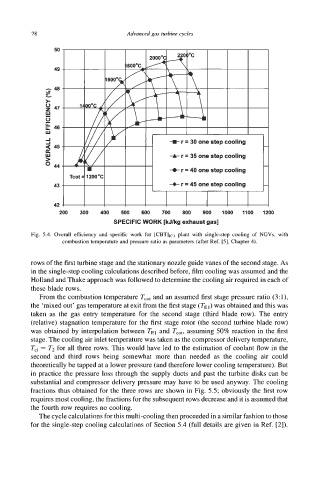
          Fig. 5.4.  Overall  efficiency  and  specific  work  for  [cB'l'lrcl plant  with  single-step cooling of  NGVs,  with
                   combustion temperature and pressure ratio as parameters (after Ref. [5], Chapter 4).


          rows of the first turbine stage and the stationary nozzle guide vanes of the second stage. As
          in the single-step cooling calculations described before, film cooling was assumed and the
          Holland and Thake approach was followed to determine the cooling air required in each of
          these blade rows.
            From the combustion temperature T,,,  and an assumed first stage pressure ratio (3:1),
          the 'mixed out' gas temperature at exit from the first stage (TEI) was obtained and this was
          taken as the  gas entry temperature for the  second stage (third blade row).  The entry
          (relative) stagnation temperature for the first stage rotor (the second turbine blade row)
          was obtained by  interpolation between TEI and Tcot, assuming 50% reaction in the first
          stage. The cooling air inlet temperature was taken as the compressor delivery temperature,
          Tci = T2 for all three rows. This would have led to the estimation of coolant flow in the
          second  and  third  rows  being  somewhat  more  than  needed  as  the  cooling  air  could
          theoretically be tapped at a lower pressure (and therefore lower cooling temperature). But
          in practice the pressure loss through the supply ducts and past the turbine disks can be
          substantial and compressor delivery pressure may have to be used anyway. The cooling
          fractions thus obtained for the three rows are shown in Fig. 5.5; obviously the first row
          requires most cooling, the fractions for the subsequent rows decrease and it is assumed that
          the fourth row requires no cooling.
            The cycle calculations for this multi-cooling then proceeded in a similar fashion to those
          for the single-step cooling calculations of Section 5.4 (full details are given in Ref. [2]).

