


Page 110 - Advanced Gas Turbine Cycles
P. 110
Chapter 5.  Full calculations of plant eficiency   83

                      2 0.4000 ,


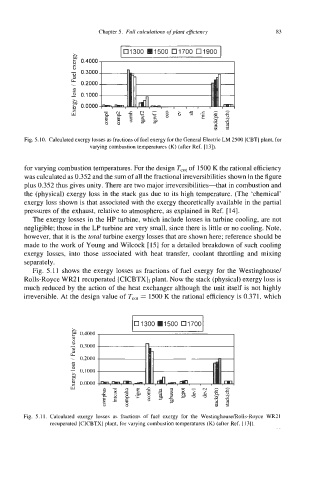
        Fig. 5.10. Calculated exergy losses as fractions of fuel exergy for the General Electric LM 2500 [CBT] plant, for
                          varying combustion temperatures (K) (after Ref. [13]).


        for varying combustion temperatures. For the design T,,,  of  1500 K the rational efficiency
        was calculated as 0.352 and the sum of all the fractional irreversibilities shown in the figure
        plus 0.352 thus gives unity. There are two major irreversibilities-that  in combustion and
        the (physical) exergy loss in the stack gas due to its high temperature. (The ‘chemical’
        exergy loss shown is that associated with the exergy theoretically available in the partial
        pressures of the exhaust, relative to atmosphere, as explained in Ref. [ 141.
          The exergy losses in the HP turbine, which include losses in turbine cooling, are not
        negligible; those in the LP turbine are very small, since there is little or no cooling. Note,
        however, that it is the total turbine exergy losses that are shown here; reference should be
        made to the work of Young and Wilcock [15] for a detailed breakdown of  such cooling
        exergy  losses, into  those  associated with  heat  transfer, coolant throttling and  mixing
        separately.
          Fig. 5.1 1  shows the exergy losses as fractions of fuel exergy for the Westinghouse/
        Rolls-Royce WR21 recuperated [CICBTX], plant. Now the stack (physical) exergy loss is
        much reduced by  the action of the heat exchanger although the unit itself is not highly
        irreversible. At the design value of T,,,  = 1500 K the rational efficiency is 0.371, which


                        0.4000


                        0.2000

                        0. I owl
                        0.oooO


        Fig.  5.1 1.  Calculated  exergy  losses  as  fractions  of  fuel  exergy  for  the  WestinghousedRolls-Royce  WR21
               recuperated [CICBTX] plant, for varying combustion temperatures (K) (after Ref. [13]).

