


Page 115 - Advanced Gas Turbine Cycles
P. 115
88                        Advanced gas turbine cycles


                                                          LOW s


                    T13
                       I
                                        HEAT TRANSFERRED
                                                        OPTIMUM S
                                                      Maximum steam exit
                                                      temperature
                         STEAM / WATER
                                                      Minimum pinch point
                                                      temperature
                                        HEAT TRANSFERRED       difference

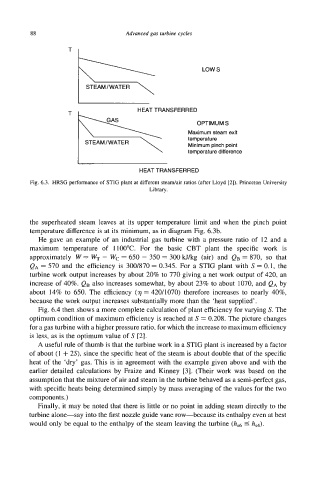
          Fig. 6.3.  HRSG performance of STIG plant at different steam/air ratios (after Lloyd [2]). Princeton University
                                           Library.


         the superheated steam leaves at its upper temperature limit and  when the pinch point
         temperature difference is at its minimum, as in diagram Fig. 6.3b.
            He gave an example of  an industrial gas turbine with  a pressure ratio of  12 and a
         maximum  temperature  of  1100°C.  For  the  basic  CBT  plant  the  specific  work  is
         approximately  W = WT - Wc = 650 - 350 = 300 kJkg  (air)  and  QB = 870,  so  that
         QA  = 570 and  the efficiency is  300/870 = 0.345. For  a STIG plant with  S = 0.1,  the
         turbine work output increases by about 20% to 770 giving a net work output of 420, an
         increase of 40%. QB also increases somewhat, by  about 23% to about  1070, and QA  by
         about  14% to  650. The  efficiency  (7) = 420/1070) therefore increases to nearly 40%,
         because the work output increases substantially more than the ‘heat supplied’.
            Fig. 6.4 then shows a more complete calculation of plant efficiency for varying S. The
         optimum condition of maximum efficiency is reached at S = 0.208. The picture changes
         for a gas turbine with a higher pressure ratio, for which the increase to maximum efficiency
         is less, as is the optimum value of S [2].
            A useful rule of thumb is that the turbine work in a STIG plant is increased by a factor
         of about (1 + 2S), since the specific heat of the steam is about double that of the specific
         heat of the  ‘dry’ gas. This is in agreement with the example given above and with the
         earlier detailed calculations by  Fraize and  Kinney  [3].  (Their work  was based  on the
         assumption that the mixture of air and steam in the turbine behaved as a semi-perfect gas,
         with specific heats being determined simply by mass averaging of the values for the two
         components.)
            Finally, it may be noted that there is little or no point in adding steam directly to the
         turbine alone-say  into the first nozzle guide vane row-because  its enthalpy even at best
         would only be equal to the enthalpy of the steam leaving the turbine (hs6 5 h&).

