


Page 119 - Advanced Gas Turbine Cycles
P. 119
Chapter 6. ‘Wet’ gas turbine plants           91

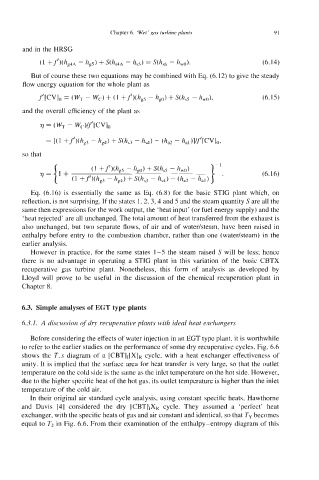
       and in the HRSG


          But of course these two equations may be combined with Eq. (6.12) to give the steady
       flow energy equation for the whole plant as


       so that


                                                                           (6.16)

          Eq.  (6.16) is essentially the  same as Eq.  (6.8) for the basic  STIG plant  which, on
       reflection, is not surprising. If the states 1,2,3,4 and 5 and the steam quantity S are all the
       same then expressions for the work output, the ‘heat input’ (or fuel energy supply) and the
       ‘heat rejected’ are all unchanged. The total amount of heat transferred from the exhaust is
       also unchanged, but two separate flows, of  air and of  watedsteam, have been raised in
       enthalpy before entry to the combustion chamber, rather than one (water/steam) in the
       earlier analysis.
          However in practice, for the same states  1-5  the steam raised S will be less; hence
       there is  no  advantage in  operating a STIG plant  in  this variation of  the  basic  CBTX
       recuperative  gas  turbine  plant.  Nonetheless,  this  form  of  analysis  as  developed  by
       Lloyd  will  prove to be  useful  in  the  discussion of  the chemical recuperation plant  in
       Chapter 8.

       6.3.  Simple analyses of EGT type plants

       63.1.  A discussion  of  dry recuperative plants with ideal heat exchangers

          Before considering the effects of water injection in an EGT type plant, it is worthwhile
       to refer to the earlier studies on the performance of some dry recuperative cycles. Fig. 6.6
       shows the  T,s diagram of  a  [CBTlI[XlR cycle, with a heat exchanger effectiveness of
       unity. It is implied that the surface area for heat transfer is very large, so that the outlet
       temperature on the cold side is the same as the inlet temperature on the hot side. However,
       due to the higher specific heat of the hot gas, its outlet temperature is higher than the inlet
       temperature of the cold air.
         In their original air standard cycle analysis, using constant specific heats, Hawthorne
       and  Davis  141  considered  the  dry  [CBT],XR cycle.  They  assumed  a  ‘perfect’ heat
       exchanger, with the specific heats of gas and air constant and identical, so that Ty becomes
       equal to T2 in Fig. 6.6. From their examination of the enthalpy-entropy  diagram of this

