


Page 121 - Advanced Gas Turbine Cycles
P. 121
Chapter 6. ‘Wet’ gas turbine plants           93
             0.8


             0.7

             0.6
           b
           0
           z
           g 0.5
           0
           LL
           LL
           w  0.4
           2
             0.3
           W
           I
           I-
             0.2

             0.1

              0
                1          1.5         2          2.5         3          3.5
                               ISENTROPIC TEMPERATURE RATIO
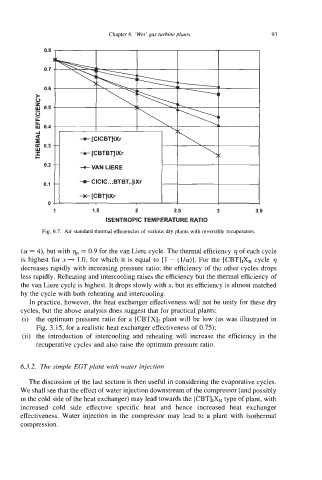
             Fig. 6.7. Air standard thermal efficiencies of various dry plants with reversible recuperators.


       (a = 4), but with rip = 0.9 for the van Liere cycle. The thermal efficiency 7 of each cycle
       is highest for x-  1.0, for which it is equal to [l  - (l/a)]. For the  [CBT],XR cycle 7
       decreases rapidly with increasing pressure ratio; the efficiency of the other cycles drops
       less rapidly. Reheating and intercooling raises the efficiency but the thermal efficiency of
       the van Liere cycle is highest. It drops slowly with x, but its efficiency is almost matched
       by the cycle with both reheating and intercooling.
         In practice, however, the heat exchanger effectiveness will not be unity for these dry
       cycles, but the above analysis does suggest that for practical plants:
       (i)  the optimum pressure ratio for a [CBTXII plant will be low (as was illustrated in
           Fig. 3.15, for a realistic heat exchanger effectiveness of 0.75);
       (ii)  the  introduction of  intercooling and  reheating will increase the efficiency in  the
           recuperative cycles and also raise the optimum pressure ratio.


       6.3.2. The simple EGT plant with water injection

         The discussion of the last section is then useful in considering the evaporative cycles.
       We shall see that the effect of water injection downstream of the compressor (and possibly
       in the cold side of the heat exchanger) may lead towards the [CBT]1XR type of plant, with
       increased  cold  side  effective  specific  heat  and  hence  increased  heat  exchanger
       effectiveness. Water  injection in  the  compressor may  lead  to  a  plant with  isothermal
       compression.

