


Page 125 - Advanced Gas Turbine Cycles
P. 125
Chapter 6. ‘Wet’ gas turbine plants           91

              0.7


              0.6


           + 0.5
           0
           z
           w
           2 0.4
           L
           L                               +EFFICIENCY   [CBliXr DRY
           W
           4
                                           +- EFFICIENCY [CBTIiXr WET
           2 Oa3
           W
           >
           0 0.2                           -A-  MASS OF WATER INJECTED
                                               FRACTION OF AIR FLO
              0.1


               0
                 1       3       5       7       9       11      13       15
                                     PRESSURE RATIO
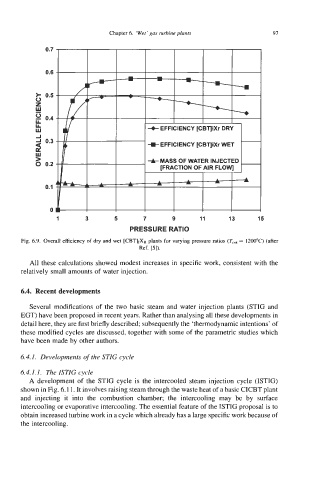
       Fig. 6.9. Overall efficiency of dry and wet [CBTIIXR plants for varying pressure ratios (Tcm = 1200°C) (after
                                        Ref. IS]).

         All these calculations showed modest increases in specific work, consistent with the
       relatively small amounts of water injection.

       6.4.  Recent developments

         Several modifications of  the two basic  steam and water injection plants (STIG and
       EGT) have been proposed in recent years. Rather than analysing all these developments in
       detail here, they are first briefly described; subsequently the ‘thermodynamic intentions’ of
       these modified cycles are discussed, together with some of the parametric studies which
       have been made by other authors.

       6.4.1. Developments of the STIG cycle

       6.4.1.1.  The ISTIG cycle
         A  development of  the  STIG cycle is the intercooled steam injection cycle (ISTIG)
       shown in Fig. 6.1 1. It involves raising steam through the waste heat of a basic CICBT plant
       and  injecting  it  into  the  combustion  chamber;  the  intercooling  may  be  by  surface
       intercooling or evaporative intercooling. The essential feature of the ISTIG proposal is to
       obtain increased turbine work in a cycle which already has a large specific work because of
       the intercooling.

