


Page 120 - Advanced Gas Turbine Cycles
P. 120
92                         Advanced gas turbine cycles


                             T


                               I
                                                            S
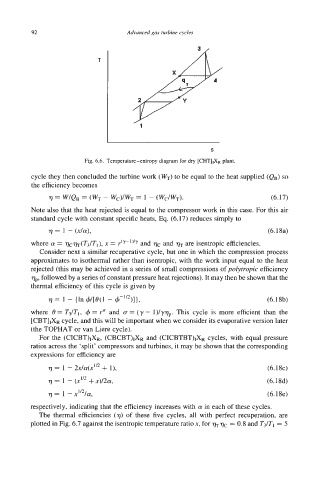
                         Fig. 6.6. Temperature-entropy  diagram for dry [CHTIIXR plant.
          cycle they then concluded the turbine work (WT) to be equal to the heat supplied (eB)
                                                                                so
          the efficiency becomes
               7 = w/&  = (w~ wc)/w~ = 1 - (wc/w~).                          (6.17)
                              -
          Note also that the heat rejected is equal to the compressor work in this case. For this air
          standard cycle with constant specific heats, Eq. (6.17) reduces simply to
               q = 1 - (x/a),                                               (6.18a)
          where a = qc%(T3/Tl), x = r(y-lyy and qc and   are isentropic efficiencies.
            Consider next a similar recuperative cycle, but one in which the compression process
          approximates to isothermal rather than isentropic, with the work input equal to the heat
          rejected (this may be achieved in a series of small compressions of polytropic efficiency
          qp, followed by a series of constant pressure heat rejections). It may then be shown that the
          thermal efficiency of this cycle is given by
               77 = 1 - (In #,qe(i  - 4-lR>]),                              (6.18b)
          where  6 = T3/TI, 4 = r"  and  (+= (y - 1)/-yqP. This  cycle  is  more  efficient than  the
          [CBT]&  cycle, and this will be important when we consider its evaporative version later
          (the TOPHAT or van Liere cycle).
            For the (CICBT)IXR, (CBCBT)rXR and (CICBTBT)IXR cycles, with equal pressure
          ratios across the 'split'  compressors and turbines, it may be shown that the corresponding
          expressions for efficiency are
               q = 1 - &/a(x'"  + 1),                                       (6.18~)
               q = 1 - (x'n + x)/2a,                                        (6.18d)
                       I"
               q= 1 -x  /a,                                                 (6.18e)
          respectively, indicating that the efficiency increases with a in each of these cycles.
            The thermal efficiencies (q) of  these five cycles, all with  perfect recuperation, are
          plotted in Fig. 6.7 against the isentropic temperature ratio x, for %qc = 0.8 and T3/T1 = 5

