


Page 156 - Advanced Gas Turbine Cycles
P. 156
126                        Advanced gas turbine cycles

                                                                        As
             It can be seen from Fig. 7.10 that the curve for dcp lies above that for dH. for the gas
          turbine  cycle  the  pressure ratio  for  maximum  efficiency in  the  combined plant  may
          be obtained by drawing a tangent to the work output curve from a point on the x-axis where
          x = 1 + qc(O - I),  i.e.  x = 4.6  in  the  example.  The  optimum  pressure  ratio  for  the
          combined plant (r = 18) is less than that for the gas turbine alone (r = 30) although it is
          still greater than the pressure ratio which gives maximum specific work in the higher plant
          (r = 1 I).  However, the efficiency qcP varies little with r about the optimum point.
             It may also be noted that by differentiating Eq. (7.9) with respect to r (or x), and putting
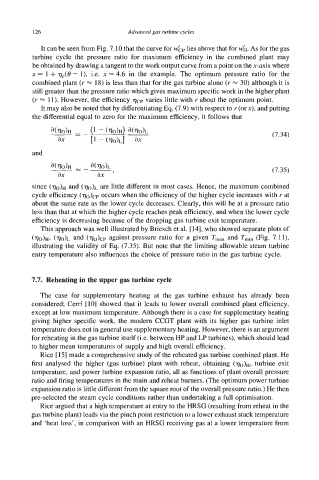
          the differential equal to zero for the maximum efficiency, it follows that

                                                                              (7.34)

          and

                                                                              (7.35)

          since (qo)H and (qo)L are little different in most cases. Hence, the maximum combined
          cycle efficiency  (7,1~)~~ occurs when the efficiency of the higher cycle increases with r at
          about the same rate as the lower cycle decreases. Clearly, this will be at a pressure ratio
          less than that at which the higher cycle reaches peak efficiency, and when the lower cycle
          efficiency is decreasing because of the dropping gas turbine exit temperature.
             This approach was well illustrated by Briesch et al. [14], who showed separate plots of
          (T~)~, (qo)L and  (qo)cp against pressure ratio for a given T,,,  and  Tmin (Fig. 7.1 I),
          illustrating the validity of Eq. (7.35). But note that the limiting allowable steam turbine
          entry temperature also influences the choice of pressure ratio in the gas turbine cycle.


          7.7.  Reheating in the upper gas turbine cycle

            The  case  for  supplementary heating  at  the  gas  turbine  exhaust  has  already  been
          considered; Cem [IO]  showed that it leads to lower overall combined plant efficiency,
          except at low maximum temperature. Although there is a case for supplementary heating
          giving higher specific work, the modem CCGT plant with its higher gas turbine inlet
          temperature does not in general use supplementary heating. However, there is an argument
          for reheating in the gas turbine itself (Le. between HP and LP turbines), which should lead
          to higher mean temperatures of supply and high overall efficiency.
            Rice [ 151 made a comprehensive study of the reheated gas turbine combined plant. He
          first analysed the higher (gas turbine) plant with reheat, obtaining ( qo)H, turbine exit
          temperature, and power turbine expansion ratio, all as functions of plant overall pressure
          ratio and firing temperatures in the main and reheat burners. (The optimum power turbine
          expansion ratio is little different from the square root of the overall pressure ratio.) He then
          pre-selected the steam cycle conditions rather than undertaking a full optimisation.
            Rice argued that a high temperature at entry to the HRSG (resulting from reheat in the
          gas turbine plant) leads via the pinch point restriction to a lower exhaust stack temperature
          and ‘heat loss’, in comparison with an HRSG receiving gas at a lower temperature from

