


Page 223 - Advanced Gas Turbine Cycles
P. 223
Appendix A.  Derivation of  required cooling Jows   I85

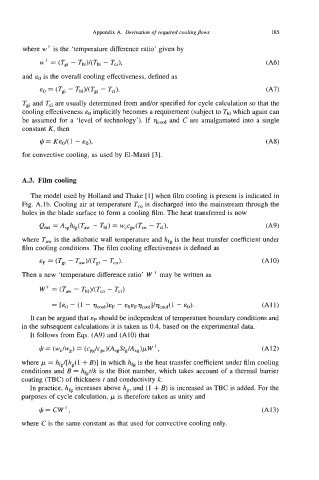
       where w+ is the 'temperature difference ratio'  given by


       and eo is the overall cooling effectiveness, defined as
            80 = (Tgi  - Tbl)/(Tgi  - Tci).

       Tgi and Tci are usually determined from and/or specified for cycle calculation so that the
       cooling effectiveness .zO implicitly becomes a requirement (subject to Tbl which again can
       be  assumed for a  'level  of  technology').  If  r)cool  and  C are amalgamated into a single
       constant K, then
                     1
            l+b = K&"/( - Eo),                                              (A8)
       for convective cooling, as used by El-Masri [3].


       A.3.  Film cooling

          The model used by Holland and Thake [ 11 when film cooling is present is indicated in
       Fig. A.lb. Cooling air at temperature Tc,  is discharged into the mainstream through the
       holes in the blade surface to form a cooling film. The heat transferred is now
            Qnet  = Asghg(Taw  - Tbl)  = Wccpc(Tco  - Tcih                  649)
       where Taw is the adiabatic wall temperature and hfg is the heat transfer coefficient under
       film cooling conditions. The film cooling effectiveness is defined as
            EF = (Tgi  - Taw>/(Tgi  - Ted.                                 ('410)

       Then a new 'temperature difference ratio'  W+ may be written as

            w+ = (Taw  - Tbl)/(Tco  - Tci)

                = [EO  - (1 - r)cool)&F  - &O&F~c0011/r)cool(l - EO).      ('41 1)
          It can be argued that cF should be independent of temperature boundary conditions and
       in the subsequent calculations it is taken as 0.4, based on the experimental data.
          It follows from Eqs. (A9) and (AlO) that

            l+b = (wc/wg> = (c,g/c,)(Asgs~,/A,g>~w+,                       (A 12)
       where p = hfg/[kg( 1 + B)] in which hf, is the heat transfer coefficient under film cooling
       conditions and B = hfgt/k is the Biot number, which takes account of a thermal barrier
       coating (TBC) of thickness r  and conductivity k.
          In practice, hfg increases above h,,  and (1 + B) is increased as TBC is added. For the
       purposes of cycle calculation, p is therefore taken as unity and
            l+b = cw+,                                                     ('41 3)

       where C is the same constant as that used for convective cooling only.

