


Page 228 - Advanced Gas Turbine Cycles
P. 228
190                        Advanced gas turbine cycles

          (kWh/kg), so that


          In a comparison between two competitive plants, one may have higher efficiency (and
          hence lower fuel cost) but may incur higher capital and maintenance costs. These effects
          have to be balanced against each other in the assessment of the relative economic merits of
          two plants.


          B.3.  The capital charge factor
             The capital charge factor (P) multiplied by the capital cost of the plant (CO) gives the
          cost of  servicing the total  capital required. Suppose the capital costs of  a plant at the
          beginning of the first year is CO and the plant has a life of N years so an annual amount
          must be provided which is (Coi + B). The first term (COi) is the simple interest payment
          and the second (B) matures into the capital repayment after N years (i.e. interest added to
          the accumulated sum at the end of each year), thus
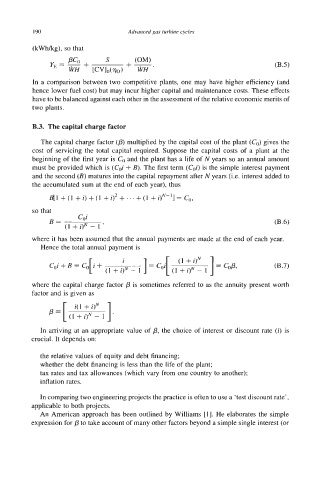
                  +(I +i)+(l+i)2+...+(1+i)N-']=~0,
          so that
                       C0 i
               B=
                   (1  +i)N  - 1
          where it has been assumed that the annual payments are made at the end of each year.
             Hence the total annual payment is


          where the capital charge factor P is sometimes referred to as the annuity present worth
          factor and is given as


            In  arriving at an appropriate value of p, the choice of  interest or discount rate (i)  is
          crucial. It depends on:

            the relative values of equity and debt financing;
            whether the debt financing is less than the life of the plant;
            tax rates and tax allowances (which vary from one country to another);
            inflation rates.

            In comparing two engineering projects the practice is often to use a 'test discount rate',
          applicable to both projects.
            An American approach has been outlined by  Williams [l].  He elaborates the simple
          expression for P to take account of many other factors beyond a simple single interest (or

