


Page 229 - Advanced Gas Turbine Cycles
P. 229
Appendix E.  Economics of gas turbine plants     191

        discount) rate. He defines a discount rate as
            i  = ‘Yere + (1 - T)(Ydrd,                                      (B.8)
        where  ae, ad  are  the  fractions  of  investment  from  equity  and  debt,  re,  rd  are  the
       corresponding annual rates of return and T is the corporate tax rate.


       B.4. Examples of electricity pricing

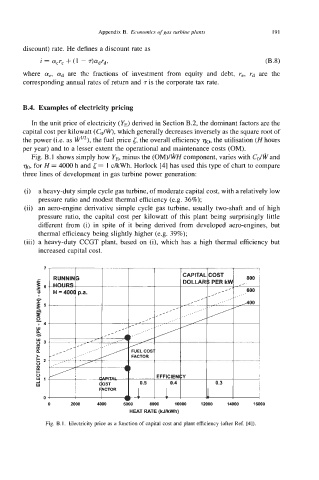
          In the unit price of electricity (YE)  derived in Section B.2, the dominant factors are the
       capital cost per kilowatt (Co/m, which generally decreases inversely as the square root of
       the power (i.e. as Win), the fuel price [, the overall efficiency T~, the utilisation (H hours
       per year) and to a lesser extent the operational and maintenance costs (OM).
          Fig. B. 1 shows simply how YE, minus the (OM)/WH component, varies with Co/W and
        m, for H = 4ooo h and 6 = 1 ckwh. Horlock [4] has used this type of chart to compare
       three lines of development in gas turbine power generation:

        (i)  a heavy-duty simple cycle gas turbine, of moderate capital cost, with a relatively low
            pressure ratio and modest thermal efficiency (e.g. 36%);
        (ii)  an aero-engine derivative simple cycle gas turbine, usually two-shaft and of  high
            pressure ratio,  the capital cost per kilowatt of  this plant being  surprisingly little
            different from  (i)  in  spite of  it  being  derived from  developed aero-engines, but
            thermal efficiency being slightly higher (e.g. 39%);
        (iii)  a heavy-duty CCGT plant, based  on  (i), which has a high thermal efficiency but


               0     zoo0   4ooo           m      1m      12OOo   14000   18ooo
                                      HEAT RATE (kJkWh)
              Fig. B. 1.  Electricity  price as a function of  capital cost and plant efficiency (after Ref.  [4]).

