


Page 122 - Advances in bioenergy (2016)
P. 122
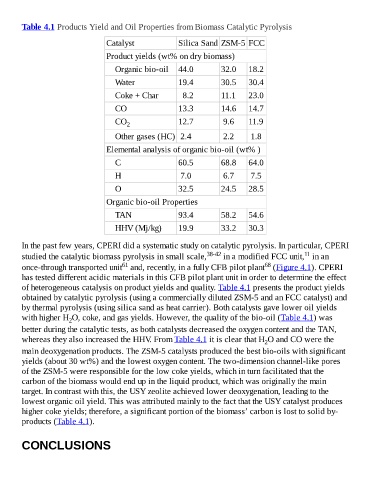
Table 4.1 Products Yield and Oil Properties from Biomass Catalytic Pyrolysis

                                    Catalyst                Silica Sand ZSM-5 FCC

                                    Product yields (wt% on dry biomass)

                                     Organic bio-oil        44.0          32.0     18.2
                                     Water                  19.4          30.5     30.4

                                     Coke + Char              8.2         11.1     23.0

                                     CO                     13.3          14.6     14.7
                                     CO    2                12.7           9.6     11.9


                                     Other gases (HC)  2.4                 2.2      1.8
                                    Elemental analysis of organic bio-oil (wt% )

                                     C                      60.5          68.8     64.0

                                     H                       7.0           6.7      7.5
                                     O                      32.5          24.5     28.5

                                    Organic bio-oil Properties

                                     TAN                    93.4          58.2     54.6
                                     HHV (Mj/kg)            19.9          33.2     30.3


        In the past few years, CPERI did a systematic study on catalytic pyrolysis. In particular, CPERI
                                                                                                      11
        studied the catalytic biomass pyrolysis in small scale,      38-42  in a modified FCC unit,  in an
                                         61
                                                                                        68
        once-through transported unit  and, recently, in a fully CFB pilot plant  (Figure 4.1). CPERI
        has tested different acidic materials in this CFB pilot plant unit in order to determine the effect
        of heterogeneous catalysis on product yields and quality. Table 4.1 presents the product yields
        obtained by catalytic pyrolysis (using a commercially diluted ZSM-5 and an FCC catalyst) and
        by thermal pyrolysis (using silica sand as heat carrier). Both catalysts gave lower oil yields
        with higher H O, coke, and gas yields. However, the quality of the bio-oil (Table 4.1) was
                        2
        better during the catalytic tests, as both catalysts decreased the oxygen content and the TAN,
        whereas they also increased the HHV. From Table 4.1 it is clear that H O and CO were the
                                                                                        2
        main deoxygenation products. The ZSM-5 catalysts produced the best bio-oils with significant
        yields (about 30 wt%) and the lowest oxygen content. The two-dimension channel-like pores
        of the ZSM-5 were responsible for the low coke yields, which in turn facilitated that the
        carbon of the biomass would end up in the liquid product, which was originally the main
        target. In contrast with this, the USY zeolite achieved lower deoxygenation, leading to the
        lowest organic oil yield. This was attributed mainly to the fact that the USY catalyst produces
        higher coke yields; therefore, a significant portion of the biomass’ carbon is lost to solid by-
        products (Table 4.1).


        CONCLUSIONS

