


Page 205 - Advances in bioenergy (2016)
P. 205
have elaborated about dry autothermal reforming of glycerol process, where they emphasize
        for such operations based on four main thermodynamic parameters such as temperature,
        pressure, OCGR [feed O /C (C of glycerol only) ratio], and CGR (feed CO  to glycerol
                                    2
                                                                                              2
               70
        ratio).  The role of oxygen addition was to enhance the conversion of C –C  products and to
                                                                                          1
                                                                                               4
        promote the oxidation of coke and coke precursors from the catalyst surface by enhancing the
        production of hydrogen, as supported by Swami and Abraham and Wang et al.               58,71-79  On the
        basis of Damkohler number and Wagner criteria, Swami and Abraham concluded that the steam
        reforming reaction for glycerol was surface-reaction controlled at lower temperatures (550–

        650°C) and mass-transfer controlled at higher temperatures (700–850°C).             58,80

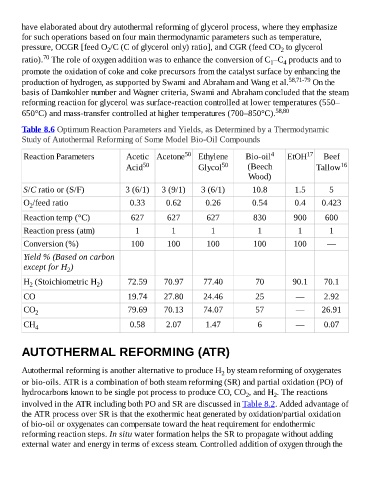
        Table 8.6 Optimum Reaction Parameters and Yields, as Determined by a Thermodynamic
        Study of Autothermal Reforming of Some Model Bio-Oil Compounds


         Reaction Parameters               Acetic Acetone     50   Ethylene       Bio-oil 4     EtOH  17    Beef
                                           Acid 50                 Glycol 50       (Beech                Tallow   16
                                                                                   Wood)
         S/C ratio or (S/F)               3 (6/1)     3 (9/1)      3 (6/1)          10.8          1.5         5

         O /feed ratio                      0.33        0.62         0.26           0.54          0.4      0.423
           2
         Reaction temp (°C)                 627         627          627             830          900       600

         Reaction press (atm)                 1           1            1              1            1          1

         Conversion (%)                     100         100          100             100          100        —
         Yield % (Based on carbon
         except for H )
                       2
         H  (Stoichiometric H )            72.59       70.97        77.40            70           90.1      70.1
           2                     2
         CO                                19.74       27.80        24.46            25            —        2.92

         CO  2                             79.69       70.13        74.07            57            —       26.91

         CH  4                              0.58        2.07         1.47             6            —        0.07


        AUTOTHERMAL REFORMING (ATR)


        Autothermal reforming is another alternative to produce H  by steam reforming of oxygenates
                                                                          2
        or bio-oils. ATR is a combination of both steam reforming (SR) and partial oxidation (PO) of
        hydrocarbons known to be single pot process to produce CO, CO , and H . The reactions
                                                                                  2
                                                                                           2
        involved in the ATR including both PO and SR are discussed in Table 8.2. Added advantage of
        the ATR process over SR is that the exothermic heat generated by oxidation/partial oxidation
        of bio-oil or oxygenates can compensate toward the heat requirement for endothermic
        reforming reaction steps. In situ water formation helps the SR to propagate without adding
        external water and energy in terms of excess steam. Controlled addition of oxygen through the

