


Page 206 - Advances in bioenergy (2016)
P. 206
feed can be well managed to match the heat required for SR or both for preheating and steam
        reforming as well. The O /feed molar ratio stands approximately >0.3–0.5 for ATR, whereas
                                     2
        H  yields are high comparable to that of steam reforming (O /feed > 7) and are in the range of
                                                                            2
          2
        71–80% of the stoichiometric yield with a good reproducibility.          16, 50, 57, 70  However, the
        autothermal reforming reaction was mass-transfer limited at all temperatures except at 550°C,
        because at this temperature, Damkohler number matches that of (0.254) for SR and (0.202) for
        ATR, respectively. Micro-channel and monolith reactor systems may be designed for these
        reactions. High reaction rate can be achieved by depositing the active catalyst metal in a thin
        layer on the channels, thus reducing the diffusion resistance.


        SEQUENTIAL CRACKING METHOD


        Recent development throws a stone toward sequential cracking method to produce H  from
                                                                                                        2
        bio-oils. The sequential cracking is a two-step process in which catalytic cracking of feed is
        alternated with that of catalyst regeneration step. In sequential cracking process, first step
        (Table 8.2) is carried out with the hydrocarbon feed that decomposes into H  and solid carbon
                                                                                              2
        on the metal site which further accumulates as coke on a metal catalyst surface.          20-22,33,69  During
        the second stage (regeneration step), the coke deposited on metal sites is exposed to air/O  or
                                                                                                              2
        steam in order to combust or gasify to produce CO  and this restores the catalytic activity in
                                                                  2
        the process in a recycling mode of operation to be followed sequentially. If required at least
        two or more reactors are placed in parallel, to produce H  in continuous mode by switching
                                                                          2
        the hydrocarbon and air/O  feed between the reactors in cycles. This sequential operational
                                      2
        arrangement affords an added advantage where it is easy to produce the H  and CO  in two
                                                                                            2
                                                                                                      2
        different steps, thereby saving the energy required to purify H . Varieties of supports such as
                                                                              2
        Al O , ZrO , and CeO -ZrO  have been used with platinum group of metals to produce
                                  2
           2 3
                     2
                                        2
                                                                    33, 69,73,81-85
        purified H  through this sequential cracking process.                    For comparison, energy ratio
                    2
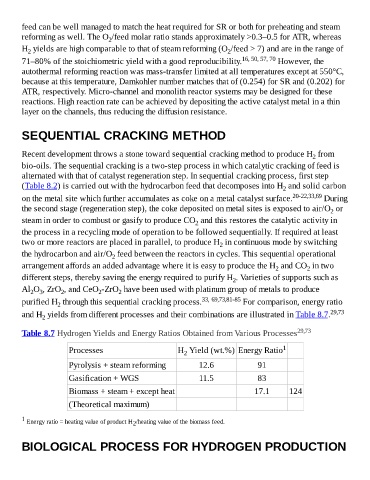
        and H  yields from different processes and their combinations are illustrated in Table 8.7.           29,73
               2
        Table 8.7 Hydrogen Yields and Energy Ratios Obtained from Various Processes                29,73

                        Processes                           H  Yield (wt.%) Energy Ratio      1
                                                              2
                        Pyrolysis + steam reforming                12.6               91
                        Gasification + WGS                         11.5               83

                        Biomass + steam + except heat                                17.1       124

                        (Theoretical maximum)

        1
          Energy ratio = heating value of product H /heating value of the biomass feed.
                                             2

        BIOLOGICAL PROCESS FOR HYDROGEN PRODUCTION

