


Page 203 - Advances in bioenergy (2016)
P. 203
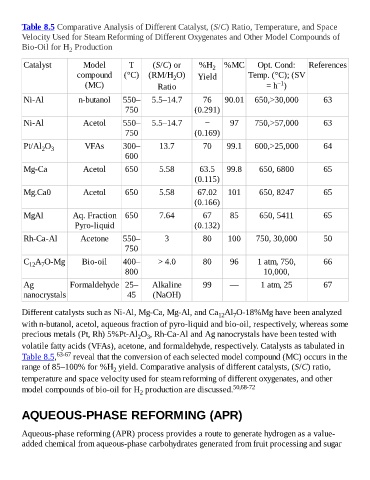
Table 8.5 Comparative Analysis of Different Catalyst, (S/C) Ratio, Temperature, and Space
        Velocity Used for Steam Reforming of Different Oxygenates and Other Model Compounds of
        Bio-Oil for H  Production
                        2

         Catalyst            Model          T      (S/C) or        %H  2   %MC        Opt. Cond:       References
                          compound        (°C)    (RM/H O)        Yield            Temp. (°C); (SV
                                                          2
                                                                                             −1
                             (MC)                    Ratio                               = h )
         Ni-Al             n-butanol      550–     5.5–14.7         76     90.01     650,>30,000            63
                                          750                    (0.291)

         Ni-Al              Acetol        550–     5.5–14.7          −       97      750,>57,000            63
                                          750                    (0.169)

         Pt/Al O             VFAs         300–        13.7          70      99.1     600,>25,000            64
               2 3
                                          600
         Mg-Ca              Acetol        650         5.58         63.5     99.8       650, 6800            65
                                                                 (0.115)

         Mg.Ca0             Acetol        650         5.58        67.02     101        650, 8247            65
                                                                 (0.166)

         MgAl            Aq. Fraction 650             7.64          67       85        650, 5411            65
                          Pyro-liquid                            (0.132)
         Rh-Ca-Al           Acetone       550–         3            80      100       750, 30,000           50

                                          750
         C A O-Mg           Bio-oil       400–       > 4.0          80       96       1 atm, 750,           66
           12 7
                                          800                                           10,000,

         Ag             Formaldehyde 25–           Alkaline         99       —         1 atm, 25            67
         nanocrystals                      45      (NaOH)


        Different catalysts such as Ni-Al, Mg-Ca, Mg-Al, and Ca Al O-18%Mg have been analyzed
                                                                         12
                                                                              7
        with n-butanol, acetol, aqueous fraction of pyro-liquid and bio-oil, respectively, whereas some
        precious metals (Pt, Rh) 5%Pt-Al O , Rh-Ca-Al and Ag nanocrystals have been tested with
                                               2 3
        volatile fatty acids (VFAs), acetone, and formaldehyde, respectively. Catalysts as tabulated in
        Table 8.5,  63-67  reveal that the conversion of each selected model compound (MC) occurs in the
        range of 85–100% for %H  yield. Comparative analysis of different catalysts, (S/C) ratio,
                                      2
        temperature and space velocity used for steam reforming of different oxygenates, and other

        model compounds of bio-oil for H  production are discussed.           50,68-72
                                               2


        AQUEOUS-PHASE REFORMING (APR)


        Aqueous-phase reforming (APR) process provides a route to generate hydrogen as a value-
        added chemical from aqueous-phase carbohydrates generated from fruit processing and sugar

