


Page 225 - Advances in bioenergy (2016)
P. 225
catalyst exhibiting higher selectivities toward H  and CO  and lower selectivity toward CO
                                                                         2
                                                               2
        because of the enhancement of the WGS reaction. The improved catalytic performance of
        Pt/CeO  catalysts has been related to the greater ability of CeO  to release and store oxygen,
                                                                                2
                 2
        resulting in higher stability compared with Pt/Al O  catalysts.       36
                                                               2 3
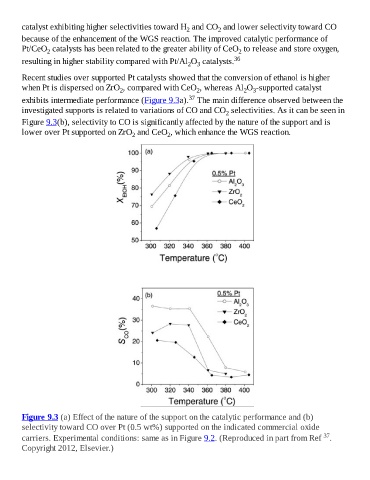
        Recent studies over supported Pt catalysts showed that the conversion of ethanol is higher
        when Pt is dispersed on ZrO , compared with CeO , whereas Al O -supported catalyst
                                                                  2
                                         2
                                                                                 2 3
                                                               37
        exhibits intermediate performance (Figure 9.3a).  The main difference observed between the
        investigated supports is related to variations of CO and CO  selectivities. As it can be seen in
                                                                            2
        Figure 9.3(b), selectivity to CO is significantly affected by the nature of the support and is
        lower over Pt supported on ZrO  and CeO , which enhance the WGS reaction.
                                             2          2


        Figure 9.3 (a) Effect of the nature of the support on the catalytic performance and (b)
        selectivity toward CO over Pt (0.5 wt%) supported on the indicated commercial oxide
                                                                                                            37
        carriers. Experimental conditions: same as in Figure 9.2. (Reproduced in part from Ref  .
        Copyright 2012, Elsevier.)

