


Page 252 - Advances in Eco-Fuels for a Sustainable Environment
P. 252
Prospects and technological advancement of cellulosic bioethanol ecofuel production  215

              Currently, most of the industrial countries are producing ethanol at a commercial
           level because of its economic aspects, environmental benefits, and engine perfor-
           mance. In 2005, Brazil produced about 4.2 billion gallons of ethanol and exported
           approximately 100 million gallons to both India and the United States [20]. The
           United States included “Renewable Fuels Standard (RFS)” as law in their energy pol-
           icy in 2005. This strategic plan increased ethanol production to 4 billion gallons in
           2006 and set a target to produce 36 billion gallons annually by 2022 [24].


           8.3   Bioethanol feedstock resources

           Typically, bioethanol is produced from the fermentation of various feedstocks that
           contain mainly fermentable sugars or carbohydrates. The available feedstocks for
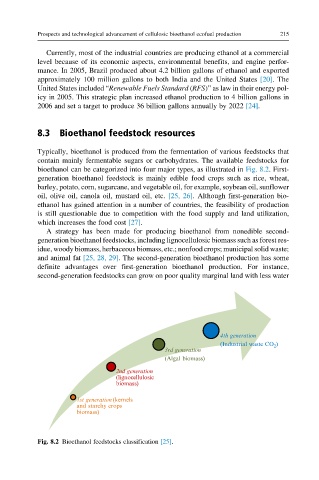
           bioethanol can be categorized into four major types, as illustrated in Fig. 8.2. First-
           generation bioethanol feedstock is mainly edible food crops such as rice, wheat,
           barley, potato, corn, sugarcane, and vegetable oil, for example, soybean oil, sunflower
           oil, olive oil, canola oil, mustard oil, etc. [25, 26]. Although first-generation bio-
           ethanol has gained attention in a number of countries, the feasibility of production
           is still questionable due to competition with the food supply and land utilization,
           which increases the food cost [27].
              A strategy has been made for producing bioethanol from nonedible second-
           generation bioethanol feedstocks, including lignocellulosic biomass such as forest res-
           idue, woody biomass, herbaceous biomass, etc.; nonfood crops; municipal solid waste;
           and animal fat [25, 28, 29]. The second-generation bioethanol production has some
           definite advantages over first-generation bioethanol production. For instance,
           second-generation feedstocks can grow on poor quality marginal land with less water


                                                             4th generation
                                                             (Industrial waste CO )
                                                                           2
                                              3rd generation
                                              (Algal biomass)
                                2nd generation
                                (lignocellulosic
                                biomass)

                      1st generation (kernels
                      and starchy crops
                      biomass)


           Fig. 8.2 Bioethanol feedstocks classification [25].

