


Page 254 - Advances in Eco-Fuels for a Sustainable Environment
P. 254
Prospects and technological advancement of cellulosic bioethanol ecofuel production  217

           as electrochemical synthesis, oxide electrolysis, and petroleum hydroprocessing is ter-
           med fourth-generation bioethanol [34, 35]. In the environmental context, fourth-
           generation bioethanol is considered carbon negative as carbon produced from this
           technology is less compared to the carbon captured. However, this technology is in
           its embryonic stage.


           8.4   Progress in bioethanol technologies

           Many investigations have been carried out to explore various feedstocks and to
           develop technologies for the conversion of these feedstocks into ethanol nowadays.
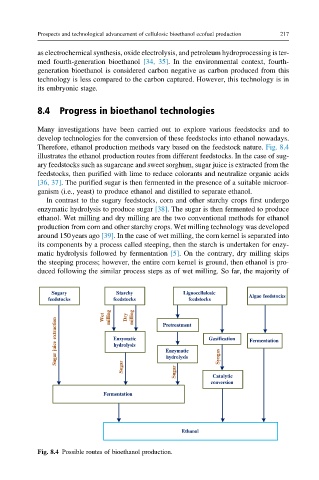
           Therefore, ethanol production methods vary based on the feedstock nature. Fig. 8.4
           illustrates the ethanol production routes from different feedstocks. In the case of sug-
           ary feedstocks such as sugarcane and sweet sorghum, sugar juice is extracted from the
           feedstocks, then purified with lime to reduce colorants and neutralize organic acids
           [36, 37]. The purified sugar is then fermented in the presence of a suitable microor-
           ganism (i.e., yeast) to produce ethanol and distilled to separate ethanol.
              In contrast to the sugary feedstocks, corn and other starchy crops first undergo
           enzymatic hydrolysis to produce sugar [38]. The sugar is then fermented to produce
           ethanol. Wet milling and dry milling are the two conventional methods for ethanol
           production from corn and other starchy crops. Wet milling technology was developed
           around 150years ago [39]. In the case of wet milling, the corn kernel is separated into
           its components by a process called steeping, then the starch is undertaken for enzy-
           matic hydrolysis followed by fermentation [5]. On the contrary, dry milling skips
           the steeping process; however, the entire corn kernel is ground, then ethanol is pro-
           duced following the similar process steps as of wet milling. So far, the majority of


               Sugary           Starchy            Lignocellulosic
              feedstocks     Wet  milling  feedstocks milling  feedstocks  Algae feedstocks

                                   Dry
                Sugar juice extraction  Enzymatic   Pretreatment  Gasification  Fermentation


                                hydrolysis
                                              Enzymatic
                                  Sugar       hydrolysis    Syngas
                                                Sugar
                                                          Catalytic
                                                          conversion
                             Fermentation


                                                  Ethanol


           Fig. 8.4 Possible routes of bioethanol production.

