


Page 325 - Advances in Renewable Energies and Power Technologies
P. 325
298    CHAPTER 9 Design Principles of Photovoltaic Irrigation Systems


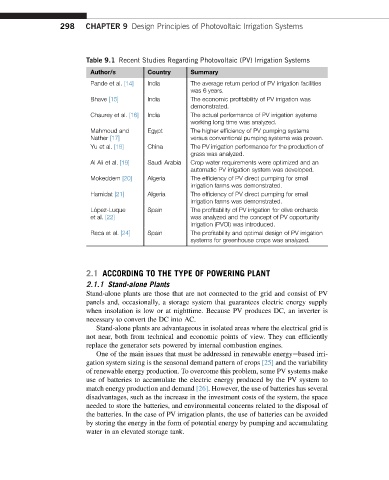
                         Table 9.1 Recent Studies Regarding Photovoltaic (PV) Irrigation Systems
                          Author/s        Country     Summary
                          Pande et al. [14]  India    The average return period of PV irrigation facilities
                                                      was 6 years.
                          Bhave [15]      India       The economic profitability of PV irrigation was
                                                      demonstrated.
                          Chaurey et al. [16]  India  The actual performance of PV irrigation systems
                                                      working long time was analyzed.
                          Mahmoud and     Egypt       The higher efficiency of PV pumping systems
                          Nather [17]                 versus conventional pumping systems was proven.
                          Yu et al. [18]  China       The PV irrigation performance for the production of
                                                      grass was analyzed.
                          Al Ali et al. [19]  Saudi Arabia  Crop water requirements were optimized and an
                                                      automatic PV irrigation system was developed.
                          Mokeddem [20]   Algeria     The efficiency of PV direct pumping for small
                                                      irrigation farms was demonstrated.
                          Hamidat [21]    Algeria     The efficiency of PV direct pumping for small
                                                      irrigation farms was demonstrated.
                          Lo ´ pez-Luque  Spain       The profitability of PV irrigation for olive orchards
                          et al. [22]                 was analyzed and the concept of PV opportunity
                                                      irrigation (PVOI) was introduced.
                          Reca et al. [24]  Spain     The profitability and optimal design of PV irrigation
                                                      systems for greenhouse crops was analyzed.


                         2.1 ACCORDING TO THE TYPE OF POWERING PLANT
                         2.1.1 Stand-alone Plants
                         Stand-alone plants are those that are not connected to the grid and consist of PV
                         panels and, occasionally, a storage system that guarantees electric energy supply
                         when insolation is low or at nighttime. Because PV produces DC, an inverter is
                         necessary to convert the DC into AC.
                            Stand-alone plants are advantageous in isolated areas where the electrical grid is
                         not near, both from technical and economic points of view. They can efficiently
                         replace the generator sets powered by internal combustion engines.
                            One of the main issues that must be addressed in renewable energyebased irri-
                         gation system sizing is the seasonal demand pattern of crops [25] and the variability
                         of renewable energy production. To overcome this problem, some PV systems make
                         use of batteries to accumulate the electric energy produced by the PV system to
                         match energy production and demand [26]. However, the use of batteries has several
                         disadvantages, such as the increase in the investment costs of the system, the space
                         needed to store the batteries, and environmental concerns related to the disposal of
                         the batteries. In the case of PV irrigation plants, the use of batteries can be avoided
                         by storing the energy in the form of potential energy by pumping and accumulating
                         water in an elevated storage tank.

