


Page 327 - Advances in Renewable Energies and Power Technologies
P. 327
300    CHAPTER 9 Design Principles of Photovoltaic Irrigation Systems


                         2.2 ACCORDING TO THE TYPE OF IRRIGATION SYSTEM
                         PV irrigation systems are usually composed of one pump, or one set of pumps oper-
                         ating in parallel, which transfers water to either an elevated storage tank or directly
                         to the irrigation water distribution system. Therefore, two basic typologies can be
                         distinguished.

                         2.2.1 Pumping to an Elevated Tank
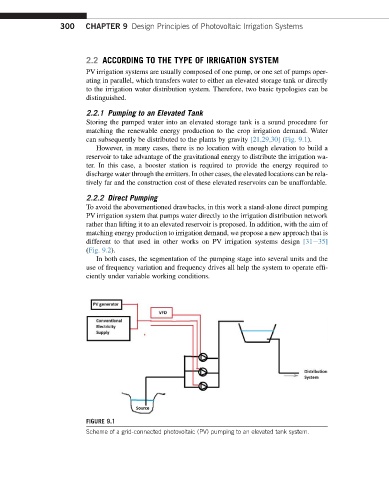
                         Storing the pumped water into an elevated storage tank is a sound procedure for
                         matching the renewable energy production to the crop irrigation demand. Water
                         can subsequently be distributed to the plants by gravity [21,29,30] (Fig. 9.1).
                            However, in many cases, there is no location with enough elevation to build a
                         reservoir to take advantage of the gravitational energy to distribute the irrigation wa-
                         ter. In this case, a booster station is required to provide the energy required to
                         discharge water through the emitters. In other cases, the elevated locations can be rela-
                         tively far and the construction cost of these elevated reservoirs can be unaffordable.

                         2.2.2 Direct Pumping
                         To avoid the abovementioned drawbacks, in this work a stand-alone direct pumping
                         PV irrigation system that pumps water directly to the irrigation distribution network
                         rather than lifting it to an elevated reservoir is proposed. In addition, with the aim of
                         matching energy production to irrigation demand, we propose a new approach that is
                         different to that used in other works on PV irrigation systems design [31e35]
                         (Fig. 9.2).
                            In both cases, the segmentation of the pumping stage into several units and the
                         use of frequency variation and frequency drives all help the system to operate effi-
                         ciently under variable working conditions.


                         FIGURE 9.1
                         Scheme of a grid-connected photovoltaic (PV) pumping to an elevated tank system.

