


Page 331 - Advances in Renewable Energies and Power Technologies
P. 331
304    CHAPTER 9 Design Principles of Photovoltaic Irrigation Systems


                                                                    I G
                                                                             +
                                                                    N
                                        1       2                    p

                                        2
                                                                           V G


                                        N s
                                                                             –
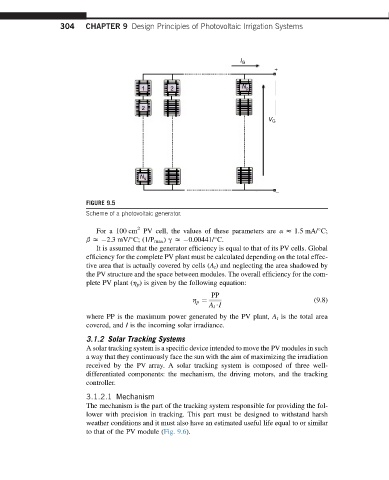
                         FIGURE 9.5
                         Scheme of a photovoltaic generator.

                                       2

                            For a 100 cm PV cell, the values of these parameters are a z 1.5 mA/ C;

                         b z  2.3 mV/ C; (1/P max ) g z  0.00441/ C.

                            It is assumed that the generator efficiency is equal to that of its PV cells. Global
                         efficiency for the complete PV plant must be calculated depending on the total effec-
                         tive area that is actually covered by cells (A t ) and neglecting the area shadowed by
                         the PV structure and the space between modules. The overall efficiency for the com-
                         plete PV plant (h p ) is given by the following equation:
                                                            PP
                                                      h ¼                               (9.8)
                                                       p
                                                           A t $I
                         where PP is the maximum power generated by the PV plant, A t is the total area
                         covered, and I is the incoming solar irradiance.
                         3.1.2 Solar Tracking Systems
                         A solar tracking system is a specific device intended to move the PV modules in such
                         a way that they continuously face the sun with the aim of maximizing the irradiation
                         received by the PV array. A solar tracking system is composed of three well-
                         differentiated components: the mechanism, the driving motors, and the tracking
                         controller.
                         3.1.2.1 Mechanism
                         The mechanism is the part of the tracking system responsible for providing the fol-
                         lower with precision in tracking. This part must be designed to withstand harsh
                         weather conditions and it must also have an estimated useful life equal to or similar
                         to that of the PV module (Fig. 9.6).

