


Page 333 - Advances in Renewable Energies and Power Technologies
P. 333
306    CHAPTER 9 Design Principles of Photovoltaic Irrigation Systems


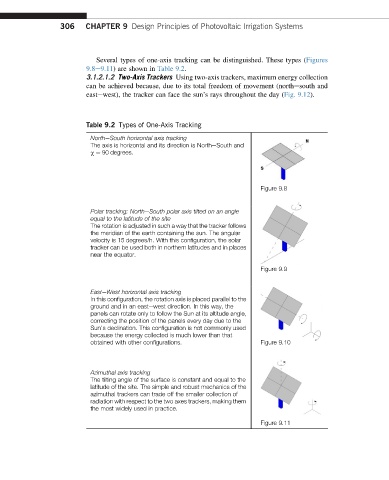
                            Several types of one-axis tracking can be distinguished. These types (Figures
                         9.8e9.11) are shown in Table 9.2.
                         3.1.2.1.2 Two-Axis Trackers Using two-axis trackers, maximum energy collection
                         can be achieved because, due to its total freedom of movement (northesouth and
                         eastewest), the tracker can face the sun’s rays throughout the day (Fig. 9.12).


                         Table 9.2 Types of One-Axis Tracking

                          NortheSouth horizontal axis tracking
                          The axis is horizontal and its direction is NortheSouth and
                          c ¼ 90 degrees.


                                                                         Figure 9.8


                          Polar tracking: NortheSouth polar axis tilted on an angle
                          equal to the latitude of the site
                          The rotation is adjusted in such a way that the tracker follows
                          the meridian of the earth containing the sun. The angular
                          velocity is 15 degrees/h. With this configuration, the solar
                          tracker can be used both in northern latitudes and in places
                          near the equator.
                                                                         Figure 9.9


                          EasteWest horizontal axis tracking
                          In this configuration, the rotation axis is placed parallel to the
                          ground and in an eastewest direction. In this way, the
                          panels can rotate only to follow the Sun at its altitude angle,
                          correcting the position of the panels every day due to the
                          Sun’s declination. This configuration is not commonly used
                          because the energy collected is much lower than that
                          obtained with other configurations.             Figure 9.10


                          Azimuthal axis tracking
                          The tilting angle of the surface is constant and equal to the
                          latitude of the site. The simple and robust mechanics of the
                          azimuthal trackers can trade off the smaller collection of
                          radiation with respect to the two axes trackers, making them
                          the most widely used in practice.

                                                                         Figure 9.11

