


Page 334 - Advances in Renewable Energies and Power Technologies
P. 334
3. Photovoltaic Irrigation Systems Components   307


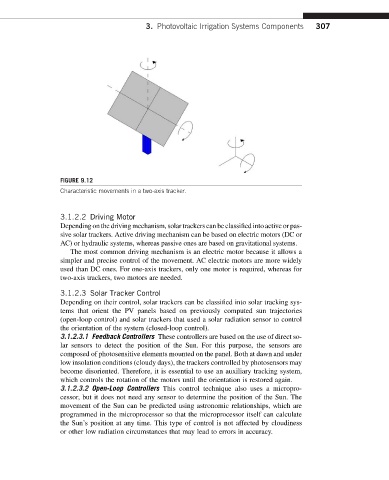
                  FIGURE 9.12
                  Characteristic movements in a two-axis tracker.


                  3.1.2.2 Driving Motor
                  Depending on the driving mechanism, solar trackers can be classified into active or pas-
                  sive solar trackers. Active driving mechanism can be based on electric motors (DC or
                  AC) or hydraulic systems, whereas passive ones are based on gravitational systems.
                     The most common driving mechanism is an electric motor because it allows a
                  simpler and precise control of the movement. AC electric motors are more widely
                  used than DC ones. For one-axis trackers, only one motor is required, whereas for
                  two-axis trackers, two motors are needed.
                  3.1.2.3 Solar Tracker Control
                  Depending on their control, solar trackers can be classified into solar tracking sys-
                  tems that orient the PV panels based on previously computed sun trajectories
                  (open-loop control) and solar trackers that used a solar radiation sensor to control
                  the orientation of the system (closed-loop control).
                  3.1.2.3.1 Feedback Controllers These controllers are based on the use of direct so-
                  lar sensors to detect the position of the Sun. For this purpose, the sensors are
                  composed of photosensitive elements mounted on the panel. Both at dawn and under
                  low insolation conditions (cloudy days), the trackers controlled by photosensors may
                  become disoriented. Therefore, it is essential to use an auxiliary tracking system,
                  which controls the rotation of the motors until the orientation is restored again.
                  3.1.2.3.2 Open-Loop Controllers This control technique also uses a micropro-
                  cessor, but it does not need any sensor to determine the position of the Sun. The
                  movement of the Sun can be predicted using astronomic relationships, which are
                  programmed in the microprocessor so that the microprocessor itself can calculate
                  the Sun’s position at any time. This type of control is not affected by cloudiness
                  or other low radiation circumstances that may lead to errors in accuracy.

