


Page 339 - Advances in Renewable Energies and Power Technologies
P. 339
312    CHAPTER 9 Design Principles of Photovoltaic Irrigation Systems


                         3.2.1 Pumping System
                         Pumping systems are usually composed of one or more than one centrifugal pumps
                         arranged in parallel. Early PV pumping systems used fixed speed pumps driven by
                         electric motors, and their design and management was considerably simpler.
                            Today, to pump variable flowrates to different total heads efficiently, variable
                         speed pumps are commonly used in these systems. Variable speed pumps are pow-
                         ered by an asynchronous motor and an electronic frequency converter that allows the
                         pump to work under different angular velocities. The frequency converter can be
                         considered as an inverter that is able to modulate the output signal to the desired fre-
                         quency and amplitude.
                            Because the power supplied by the PV array is variable throughout the
                         day depending on the incoming radiation, the power required by the pump can be
                         modified by modifying the angular velocity of the pump to match the incoming
                         power.
                            To select the most appropriate pump for a specific application, the performance
                         curves (Discharge-Head-Efficiency) of the pump provided by the manufacturer and
                         the affinity laws that relate the shaft power, P, the head (H), and the discharge, Q,
                         provided by the pump to its rotation speed (n) are required.
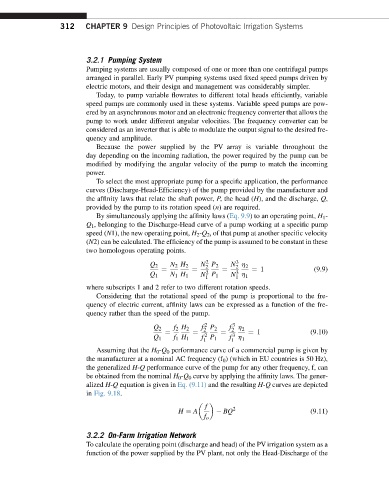
                            By simultaneously applying the affinity laws (Eq. 9.9) to an operating point, H 1 -
                         Q 1 , belonging to the Discharge-Head curve of a pump working at a specific pump
                         speed (N1), the new operating point, H 2 -Q 2 , of that pump at another specific velocity
                         (N2) can be calculated. The efficiency of the pump is assumed to be constant in these
                         two homologous operating points.
                                                          2       3
                                           Q 2  N 2 H 2  N P 2   N h 2
                                                          2
                                                                  2
                                              ¼       ¼        ¼       ¼ 1              (9.9)
                                                          2
                                                                  3
                                           Q 1  N 1 H 1  N P 1   N h 1
                                                          1       1
                         where subscripts 1 and 2 refer to two different rotation speeds.
                            Considering that the rotational speed of the pump is proportional to the fre-
                         quency of electric current, affinity laws can be expressed as a function of the fre-
                         quency rather than the speed of the pump.
                                                          2      3
                                            Q 2  f 2 H 2  f P 2  f h 2
                                                                 2
                                                         2
                                               ¼      ¼   2   ¼  3    ¼ 1              (9.10)
                                            Q 1  f 1 H 1  f P 1  f h 1
                                                         1       1
                            Assuming that the H 0 -Q 0 performance curve of a commercial pump is given by
                         the manufacturer at a nominal AC frequency (f 0 ) (which in EU countries is 50 Hz),
                         the generalized H-Q performance curve of the pump for any other frequency, f, can
                         be obtained from the nominal H 0 -Q 0 curve by applying the affinity laws. The gener-
                         alized H-Q equation is given in Eq. (9.11) and the resulting H-Q curves are depicted
                         in Fig. 9.18.

                                                          f       2
                                                  H ¼ A        BQ                      (9.11)
                                                          f o
                         3.2.2 On-Farm Irrigation Network
                         To calculate the operating point (discharge and head) of the PV irrigation system as a
                         function of the power supplied by the PV plant, not only the Head-Discharge of the

