


Page 335 - Advances in Renewable Energies and Power Technologies
P. 335
308    CHAPTER 9 Design Principles of Photovoltaic Irrigation Systems


                         3.1.3 Other Types of Photovoltaic Array Arrangements
                         In intensive crop farms or greenhouses farms, the lack of space to lay the PV system
                         is an important problem that must be faced because the price of land is usually high
                         and most of the surface area is occupied by farm facilities such as greenhouses, res-
                         ervoirs, warehouses, and irrigation facilities. The development of PV energy gener-
                         ation technology currently offers different alternatives to cope with this problem.
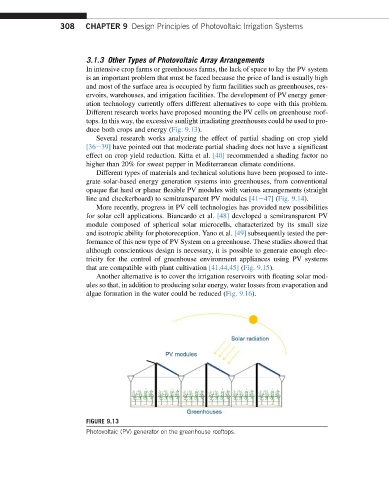
                         Different research works have proposed mounting the PV cells on greenhouse roof-
                         tops. In this way, the excessive sunlight irradiating greenhouses could be used to pro-
                         duce both crops and energy (Fig. 9.13).
                            Several research works analyzing the effect of partial shading on crop yield
                         [36e39] have pointed out that moderate partial shading does not have a significant
                         effect on crop yield reduction. Kitta et al. [40] recommended a shading factor no
                         higher than 20% for sweet pepper in Mediterranean climate conditions.
                            Different types of materials and technical solutions have been proposed to inte-
                         grate solar-based energy generation systems into greenhouses, from conventional
                         opaque flat hard or planar flexible PV modules with various arrangements (straight
                         line and checkerboard) to semitransparent PV modules [41e47] (Fig. 9.14).
                            More recently, progress in PV cell technologies has provided new possibilities
                         for solar cell applications. Biancardo et al. [48] developed a semitransparent PV
                         module composed of spherical solar microcells, characterized by its small size
                         and isotropic ability for photoreception. Yano et al. [49] subsequently tested the per-
                         formance of this new type of PV System on a greenhouse. These studies showed that
                         although conscientious design is necessary, it is possible to generate enough elec-
                         tricity for the control of greenhouse environment appliances using PV systems
                         that are compatible with plant cultivation [41,44,45] (Fig. 9.15).
                            Another alternative is to cover the irrigation reservoirs with floating solar mod-
                         ules so that, in addition to producing solar energy, water losses from evaporation and
                         algae formation in the water could be reduced (Fig. 9.16).


                         FIGURE 9.13
                         Photovoltaic (PV) generator on the greenhouse rooftops.

