


Page 344 - Advances in Renewable Energies and Power Technologies
P. 344
3. Photovoltaic Irrigation Systems Components   317


                  system can be calculated following a procedure similar to that explained in the pre-
                  vious section.
                     However, in some direct pumping systems on flat farms, when the source of wa-
                  ter is superficial, the elevation difference term Dz may be low in comparison with the
                  variable term in Eq. (9.21), which includes both the head losses in the system and the
                  pressure of the emitters. In this case, the authors demonstrated that the operating
                  point follows an isoefficiency curve and can be approximated by applying the affin-
                  ity laws.
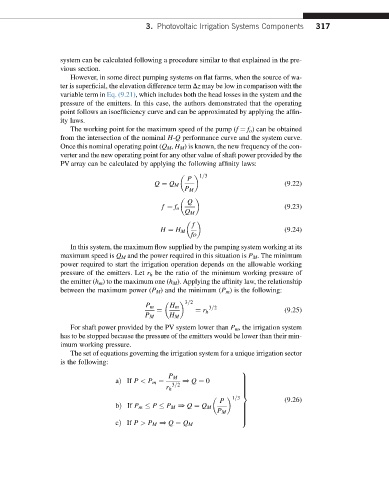
                     The working point for the maximum speed of the pump (f ¼ f o ) can be obtained
                  from the intersection of the nominal H-Q performance curve and the system curve.
                  Once this nominal operating point (Q M , H M ) is known, the new frequency of the con-
                  verter and the new operating point for any other value of shaft power provided by the
                  PV array can be calculated by applying the following affinity laws:
                                                         1=3
                                                     P
                                            Q ¼ Q M                             (9.22)
                                                    P M

                                                     Q
                                              f ¼ f o                           (9.23)
                                                    Q M

                                                      f
                                             H ¼ H M                            (9.24)
                                                      fo
                     In this system, the maximum flow supplied by the pumping system working at its
                  maximum speed is Q M and the power required in this situation is P M . The minimum
                  power required to start the irrigation operation depends on the allowable working
                  pressure of the emitters. Let r h be the ratio of the minimum working pressure of
                  the emitter (h m ) to the maximum one (h M ). Applying the affinity law, the relationship
                  between the maximum power (P M ) and the minimum (P m ) is the following:
                                                     3=2
                                         P m    H m        3=2
                                            ¼          ¼ r h                    (9.25)
                                         P M    H M
                     For shaft power provided by the PV system lower than P m , the irrigation system
                  has to be stopped because the pressure of the emitters would be lower than their min-
                  imum working pressure.
                     The set of equations governing the irrigation system for a unique irrigation sector
                  is the following:
                                                                    9
                                                P M
                                 aÞ If P < P m ¼   0 Q ¼ 0          >
                                                                    >
                                                 3=2                >
                                                                    >
                                               r h                  >
                                                                    >
                                                                    >
                                                                    =
                                                                 1=3

                                                              P                 (9.26)
                                 bÞ If P m   P   P M 0 Q ¼ Q M      >
                                                                    >
                                                             P M    >
                                                                    >
                                                                    >
                                                                    >
                                                                    >
                                                                    ;
                                 cÞ If P > P M 0 Q ¼ Q M

