


Page 346 - Advances in Renewable Energies and Power Technologies
P. 346
4. Modeling and Simulation of Photovoltaic Irrigation System  319


                       14

                       12
                                                 4 pumps on
                                        3 pumps
                       10
                                    2 pumps
                        8
                      Q (L s -1 )  6  1 pump on

                           All pumps off
                        4
                                                                      1 sector
                                                                      2 sectors
                                                      1 pump on       4 sectors
                        2                                             3 sectors
                                                                      Variable sectors
                        0
                         0      500     1000    1500   2000    2500    3000    3500
                                               Incoming power (W)
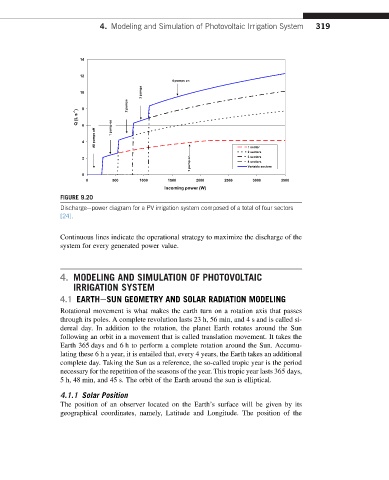
                  FIGURE 9.20
                  Dischargeepower diagram for a PV irrigation system composed of a total of four sectors
                  [24].


                  Continuous lines indicate the operational strategy to maximize the discharge of the
                  system for every generated power value.


                  4. MODELING AND SIMULATION OF PHOTOVOLTAIC
                     IRRIGATION SYSTEM
                  4.1 EARTHeSUN GEOMETRY AND SOLAR RADIATION MODELING
                  Rotational movement is what makes the earth turn on a rotation axis that passes
                  through its poles. A complete revolution lasts 23 h, 56 min, and 4 s and is called si-
                  dereal day. In addition to the rotation, the planet Earth rotates around the Sun
                  following an orbit in a movement that is called translation movement. It takes the
                  Earth 365 days and 6 h to perform a complete rotation around the Sun. Accumu-
                  lating these 6 h a year, it is entailed that, every 4 years, the Earth takes an additional
                  complete day. Taking the Sun as a reference, the so-called tropic year is the period
                  necessary for the repetition of the seasons of the year. This tropic year lasts 365 days,
                  5 h, 48 min, and 45 s. The orbit of the Earth around the sun is elliptical.

                  4.1.1 Solar Position
                  The position of an observer located on the Earth’s surface will be given by its
                  geographical coordinates, namely, Latitude and Longitude. The position of the

