


Page 348 - Advances in Renewable Energies and Power Technologies
P. 348
4. Modeling and Simulation of Photovoltaic Irrigation System  321


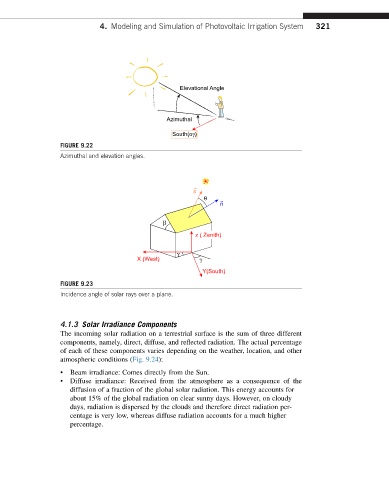
                                                   Elevational Angle


                                               Azimuthal

                                                 South(oγ)
                  FIGURE 9.22
                  Azimuthal and elevation angles.


                                                       s
                                                          θ
                                                              n

                                              β
                                                       z ( Zenith)

                                                  γ
                                       X (West)         γ

                                                         Y(South)
                  FIGURE 9.23
                  Incidence angle of solar rays over a plane.


                  4.1.3 Solar Irradiance Components
                  The incoming solar radiation on a terrestrial surface is the sum of three different
                  components, namely, direct, diffuse, and reflected radiation. The actual percentage
                  of each of these components varies depending on the weather, location, and other
                  atmospheric conditions (Fig. 9.24):
                  •  Beam irradiance: Comes directly from the Sun.
                  •  Diffuse irradiance: Received from the atmosphere as a consequence of the
                    diffusion of a fraction of the global solar radiation. This energy accounts for
                    about 15% of the global radiation on clear sunny days. However, on cloudy
                    days, radiation is dispersed by the clouds and therefore direct radiation per-
                    centage is very low, whereas diffuse radiation accounts for a much higher
                    percentage.

