


Page 347 - Advances in Renewable Energies and Power Technologies
P. 347
320    CHAPTER 9 Design Principles of Photovoltaic Irrigation Systems


                                                       z (Zenit)
                                                    k
                                                                   n

                                                        β
                                                                     s     Sun
                                                            θ
                                                     o
                                                                    i
                                            β                         y (South)

                                       x (West) j
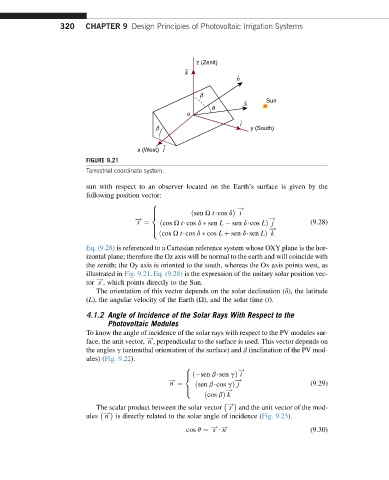
                         FIGURE 9.21
                         Terrestrial coordinate system.

                         sun with respect to an observer located on the Earth’s surface is given by the
                         following position vector:

                                           8
                                                                   !
                                                      ðsen U t$cos dÞ i
                                           >
                                           >
                                           <
                                      !                                    !
                                       s ¼   ðcos U t$cos d   sen L   sen d$cos LÞ j   (9.28)
                                           >                                !
                                           >
                                           : ðcos U t$cos d   cos L þ sen d$sen LÞ k
                         Eq. (9.28) is referenced to a Cartesian reference system whose OXY plane is the hor-
                         izontal plane; therefore the Oz axis will be normal to the earth and will coincide with
                         the zenith; the Oy axis is oriented to the south, whereas the Ox axis points west, as
                         illustrated in Fig. 9.21. Eq. (9.28) is the expression of the unitary solar position vec-
                            !
                         tor s , which points directly to the Sun.
                            The orientation of this vector depends on the solar declination (d), the latitude
                         (L), the angular velocity of the Earth (U), and the solar time (t).
                         4.1.2 Angle of Incidence of the Solar Rays With Respect to the
                               Photovoltaic Modules
                         To know the angle of incidence of the solar rays with respect to the PV modules sur-
                                          !
                         face, the unit vector, n , perpendicular to the surface is used. This vector depends on
                         the angles g (azimuthal orientation of the surface) and b (inclination of the PV mod-
                         ules) (Fig. 9.22).
                                                                   !
                                                    8
                                                    > ð sen b$sen gÞ i
                                                    <
                                                !                 !
                                                n ¼    ðsen b$cos gÞ j                 (9.29)
                                                    >          !
                                                          ðcos bÞ k
                                                    :
                                                                !

                            The scalar product between the solar vector s and the unit vector of the mod-
                              !

                         ules n is directly related to the solar angle of incidence (Fig. 9.23).
                                                           ! !
                                                     cos q ¼ s $ n                     (9.30)

