


Page 350 - Advances in Renewable Energies and Power Technologies
P. 350
4. Modeling and Simulation of Photovoltaic Irrigation System  323


                                       1
                                     0.8
                                  K d
                                     0.6
                                     0.4
                                     0.2
                                       0
                                        0    0.2  0.4   0.6  0.8   1
                                                       H
                                                   K =
                                                    T
                                                       H 0
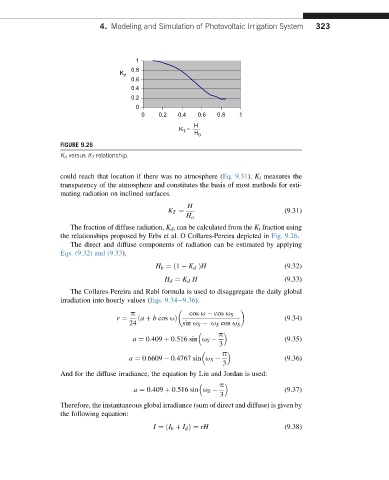
                  FIGURE 9.26
                  K d versus K T relationship.


                  could reach that location if there was no atmosphere (Eq. 9.31). K t measures the
                  transparency of the atmosphere and constitutes the basis of most methods for esti-
                  mating radiation on inclined surfaces.
                                                     H
                                                K T ¼                           (9.31)
                                                     H o
                     The fraction of diffuse radiation, K d , can be calculated from the K t fraction using
                  the relationships proposed by Erbs et al. O Collares-Pereira depicted in Fig. 9.26.
                     The direct and diffuse components of radiation can be estimated by applying
                  Eqs. (9.32) and (9.33).

                                            H b ¼ð1   K d ÞH                    (9.32)
                                               H d ¼ K d H                      (9.33)
                     The Collares-Pereira and Rabl formula is used to disaggregate the daily global
                  irradiation into hourly values (Eqs. 9.34e9.36).
                                     p               cos u   cos u S
                                 r ¼   ða þ b cos uÞ                            (9.34)
                                     24             sin u S   u S cos u S
                                                              p

                                      a ¼ 0:409 þ 0:516 sin u S                 (9.35)
                                                              3
                                                               p

                                     a ¼ 0:6609   0:4767 sin u S                (9.36)
                                                               3
                  And for the diffuse irradiance, the equation by Liu and Jordan is used:
                                                              p

                                      a ¼ 0:409 þ 0:516 sin u S                 (9.37)
                                                              3
                  Therefore, the instantaneous global irradiance (sum of direct and diffuse) is given by
                  the following equation:
                                            I ¼ðI b þ I d Þ¼ rH                 (9.38)

