


Page 342 - Advances in Renewable Energies and Power Technologies
P. 342
3. Photovoltaic Irrigation Systems Components   315


                  total flow in the irrigation sector is constant as well and can be calculated by multi-
                  plying the emitter discharge by the number of emitters per sector. In the case of
                  compensating emitters, the system curve is Q ¼ constant, and the discharge does
                  not vary even though the pump speed is changed. To overcome these limitations,
                  different procedures to regulate flow as a function of the incoming power have
                  been suggested. The first procedure is based on using variable speed pumps and non-
                  compensating emitters that vary their discharge depending on the pressure. The sec-
                  ond procedure is based on subdividing the farm into smaller-sized irrigation sectors
                  and irrigating a variable number of sectors depending on the power supplied by the
                  PV system. With these two configurations, the discharge of the irrigation system can
                  be varied to adjust the power consumed by the irrigation system to the power pro-
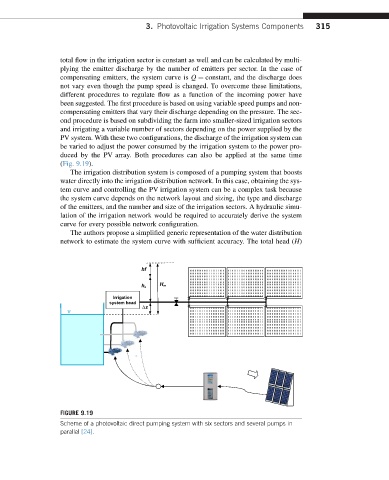
                  duced by the PV array. Both procedures can also be applied at the same time
                  (Fig. 9.19).
                     The irrigation distribution system is composed of a pumping system that boosts
                  water directly into the irrigation distribution network. In this case, obtaining the sys-
                  tem curve and controlling the PV irrigation system can be a complex task because
                  the system curve depends on the network layout and sizing, the type and discharge
                  of the emitters, and the number and size of the irrigation sectors. A hydraulic simu-
                  lation of the irrigation network would be required to accurately derive the system
                  curve for every possible network configuration.
                     The authors propose a simplified generic representation of the water distribution
                  network to estimate the system curve with sufficient accuracy. The total head (H)


                                        hf

                                             H m
                                        h e
                                Irrigation
                               system head
                                        ∆z


                  FIGURE 9.19
                  Scheme of a photovoltaic direct pumping system with six sectors and several pumps in
                  parallel [24].

