


Page 420 - Advances in Renewable Energies and Power Technologies
P. 420
4. Solar Thermal Energy Storage   393


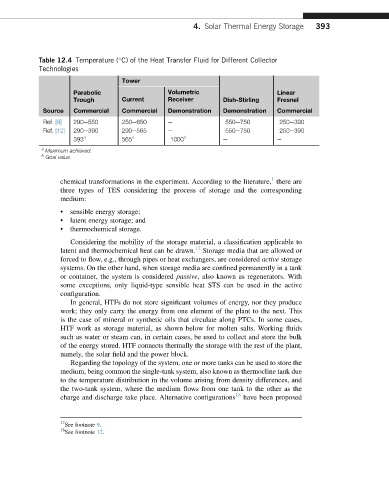
            Table 12.4 Temperature ( C) of the Heat Transfer Fluid for Different Collector

            Technologies
                                   Tower
                     Parabolic                  Volumetric                    Linear
                     Trough        Current      Receiver       Dish-Stirling  Fresnel
             Source  Commercial    Commercial   Demonstration  Demonstration  Commercial
             Ref. [9]  290e550     250e650      e              550e750        250e390
             Ref. [12]  290e390    290e565      e              550e750        250e390
                     393 a         565 a        1000 b         e              e
             a
              Maximum achieved.
             b
              Goal value.
                                                                            1
                  chemical transformations in the experiment. According to the literature, there are
                  three types of TES considering the process of storage and the corresponding
                  medium:
                  •  sensible energy storage;
                  •  latent energy storage; and
                  •  thermochemical storage.
                     Considering the mobility of the storage material, a classification applicable to
                  latent and thermochemical heat can be drawn. 17  Storage media that are allowed or
                  forced to flow, e.g., through pipes or heat exchangers, are considered active storage
                  systems. On the other hand, when storage media are confined permanently in a tank
                  or container, the system is considered passive, also known as regenerators. With
                  some exceptions, only liquid-type sensible heat STS can be used in the active
                  configuration.
                     In general, HTFs do not store significant volumes of energy, nor they produce
                  work; they only carry the energy from one element of the plant to the next. This
                  is the case of mineral or synthetic oils that circulate along PTCs. In some cases,
                  HTF work as storage material, as shown below for molten salts. Working fluids
                  such as water or steam can, in certain cases, be used to collect and store the bulk
                  of the energy stored. HTF connects thermally the storage with the rest of the plant,
                  namely, the solar field and the power block.
                     Regarding the topology of the system, one or more tanks can be used to store the
                  medium, being common the single-tank system, also known as thermocline tank due
                  to the temperature distribution in the volume arising from density differences, and
                  the two-tank system, where the medium flows from one tank to the other as the
                  charge and discharge take place. Alternative configurations 18  have been proposed


                  17
                   See footnote 9.
                  18
                   See footnote 12.

