


Page 422 - Advances in Renewable Energies and Power Technologies
P. 422
5. Thermodynamic and Economic Study       395


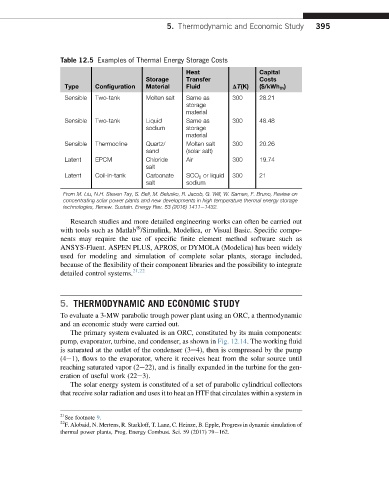
                  Table 12.5 Examples of Thermal Energy Storage Costs
                                                     Heat                Capital
                                         Storage     Transfer            Costs
                   Type    Configuration  Material    Fluid       DT(K)   ($/kWh th )
                   Sensible  Two-tank    Molten salt  Same as    300     28.21
                                                     storage
                                                     material
                   Sensible  Two-tank    Liquid      Same as     300     48.48
                                         sodium      storage
                                                     material
                   Sensible  Thermocline  Quartz/    Molten salt  300    20.26
                                         sand        (solar salt)
                   Latent  EPCM          Chloride    Air         300     19.74
                                         salt
                   Latent  Coil-in-tank  Carbonate   SCO 2 or liquid  300  21
                                         salt        sodium
                   From M. Liu, N.H. Steven Tay, S. Bell, M. Belusko, R. Jacob, G. Will, W. Saman, F. Bruno, Review on
                   concentrating solar power plants and new developments in high temperature thermal energy storage
                   technologies, Renew. Sustain. Energy Rev. 53 (2016) 1411e1432.
                     Research studies and more detailed engineering works can often be carried out
                                       Ò
                  with tools such as Matlab /Simulink, Modelica, or Visual Basic. Specific compo-
                  nents may require the use of specific finite element method software such as
                  ANSYS-Fluent. ASPEN PLUS, APROS, or DYMOLA (Modelica) has been widely
                  used for modeling and simulation of complete solar plants, storage included,
                  because of the flexibility of their component libraries and the possibility to integrate
                  detailed control systems. 21,22


                  5. THERMODYNAMIC AND ECONOMIC STUDY
                  To evaluate a 3-MW parabolic trough power plant using an ORC, a thermodynamic
                  and an economic study were carried out.
                     The primary system evaluated is an ORC, constituted by its main components:
                  pump, evaporator, turbine, and condenser, as shown in Fig. 12.14. The working fluid
                  is saturated at the outlet of the condenser (3e4), then is compressed by the pump
                  (4e1), flows to the evaporator, where it receives heat from the solar source until
                  reaching saturated vapor (2e22), and is finally expanded in the turbine for the gen-
                  eration of useful work (22e3).
                     The solar energy system is constituted of a set of parabolic cylindrical collectors
                  that receive solar radiation and uses it to heat an HTF that circulates within a system in


                  21
                   See footnote 9.
                  22
                   F. Alobaid, N. Mertens, R. Starkloff, T. Lanz, C. Heinze, B. Epple, Progress in dynamic simulation of
                  thermal power plants, Prog. Energy Combust. Sci. 59 (2017) 79e162.

